50-Year-Old Math Conjecture Finally Proven: The McKay Conjecture

2025-02-20

50-Year-Old Math Conjecture Finally Proven: The McKay Conjecture

The McKay Conjecture, a mathematical problem posed in the 1970s concerning finite groups and their Sylow normalizers, has finally been proven by Britta Späth and Michel Cabanes. The conjecture states that a crucial quantity for a finite group is equal to the same quantity for its Sylow normalizer (a much smaller subgroup). This proof, decades in the making, builds upon over a century of work classifying finite groups and involves deep insights into the representation theory of Lie-type groups. It's a monumental achievement in mathematics, simplifying group theory research and potentially leading to practical applications.

Read more


Catalytic Computing: A Breakthrough in Memory-Constrained Computation

2025-02-18
Catalytic Computing: A Breakthrough in Memory-Constrained Computation

Computer scientists have long been hampered by memory limitations, struggling to solve certain complex problems. A breakthrough came with "catalytic computing," which cleverly utilizes a large but inaccessible auxiliary memory (like a massive, uneditable hard drive). By allowing reversible tweaks to this extra memory, it boosts computational power, similar to a chemical catalyst. Initially proposed by Buhrman and Cleve, this technique has been extended and applied. James Cook, a software engineer, even applied it to previously intractable tree evaluation problems, showcasing its potential. This research challenges our traditional understanding of resource utilization, opening new avenues for solving more complex computational challenges.

Read more

60-Year-Old Math Puzzle Solved: The Optimal Sofa Size

2025-02-14
60-Year-Old Math Puzzle Solved: The Optimal Sofa Size

A 60-year-old mathematical puzzle – the moving sofa problem – has finally been solved! In the 1960s, mathematicians posed a seemingly simple geometric question: What's the largest area of a sofa that can navigate a unit-width hallway? Recently, Jineon Baek, a postdoctoral researcher at Yonsei University in Seoul, proved in a 119-page paper that the sofa shape proposed by Joseph Gerver in 1992 is the optimal solution, with an area of approximately 2.2195. Baek's proof is remarkable because it didn't rely on computers but used elegant mathematical techniques, offering new approaches to solving other optimization problems. The result also illustrates that even the simplest optimization problems can have surprisingly complex answers.

Read more

Bethe Ansatz: A Near-Perfect Quantum Theory

2025-02-13
Bethe Ansatz: A Near-Perfect Quantum Theory

Physicist Hans Bethe, while studying spin chains, developed a near-perfect quantum theory—the Bethe Ansatz. He elegantly handled the interactions of spin waves, accurately calculating energy for various states. Though initially failing to explain real-world magnets, the Bethe Ansatz proved powerful in other areas, such as explaining peculiar phenomena in low-temperature ice. Using the Bethe Ansatz, physicists could precisely calculate the probabilities of measuring specific patterns in experiments, again demonstrating the theory's perfection.

Read more

40-Year-Old Conjecture Shattered: New Hash Table Outperforms Expectations

2025-02-10
40-Year-Old Conjecture Shattered: New Hash Table Outperforms Expectations

Graduate student Krapivin (University of Cambridge), along with Farach-Colton and Kuszmaul (New York University), have overturned Yao's conjecture, a long-held belief in computer science. Their novel hash table achieves a worst-case time complexity of (log x)² for element lookups, significantly faster than the previously believed optimal x. This groundbreaking research not only solves a classic problem in hash table design but also dramatically improves data storage efficiency, sparking significant interest within the academic community.

Read more
Development hash table

Noether's Theorem: The Symmetry Behind Conservation Laws

2025-02-09
Noether's Theorem: The Symmetry Behind Conservation Laws

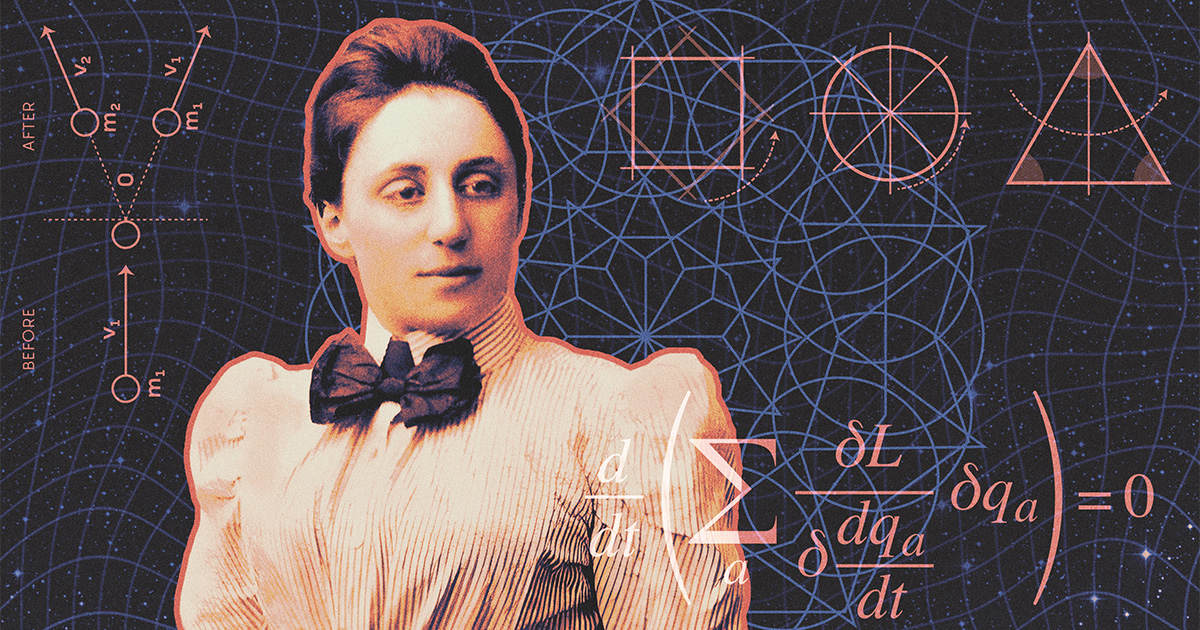
Einstein's general relativity, introduced in 1915, challenged fundamental physics by implying energy could be created and destroyed. The shifting spacetime of relativity broke the classical energy conservation law. Hilbert and Klein, unable to resolve this, passed the problem to Emmy Noether. In 1918, Noether published two groundbreaking theorems. Her theorem, now famous, revealed a profound connection: every conservation law reflects an underlying symmetry of the system. This discovery, crucial for understanding quantum field theory symmetries, profoundly impacted the course of physics.

Read more

Arctic Microalgae Defy Photosynthesis Limits

2025-02-06
Arctic Microalgae Defy Photosynthesis Limits

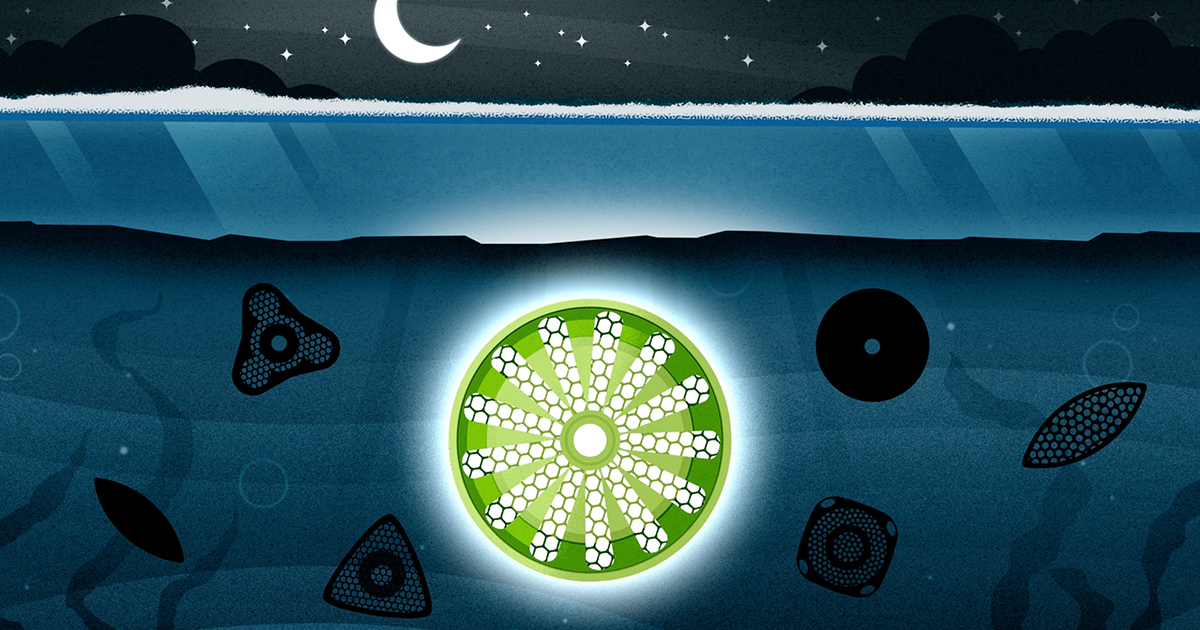
New research reveals Arctic microalgae can photosynthesize under extremely low light conditions, nearing the theoretical minimum. Researchers observed algae growth shortly after the polar night, indicating they maintain low-power operation during darkness and rapidly activate photosynthesis when light returns. This finding could reshape our understanding of Arctic ecosystems and deep-sea life, suggesting the productive ocean zone might extend deeper than previously thought.

Read more

Decoding the Universe's Shape: Unraveling the CMB's Mysterious Notes

2025-02-04
Decoding the Universe's Shape: Unraveling the CMB's Mysterious Notes

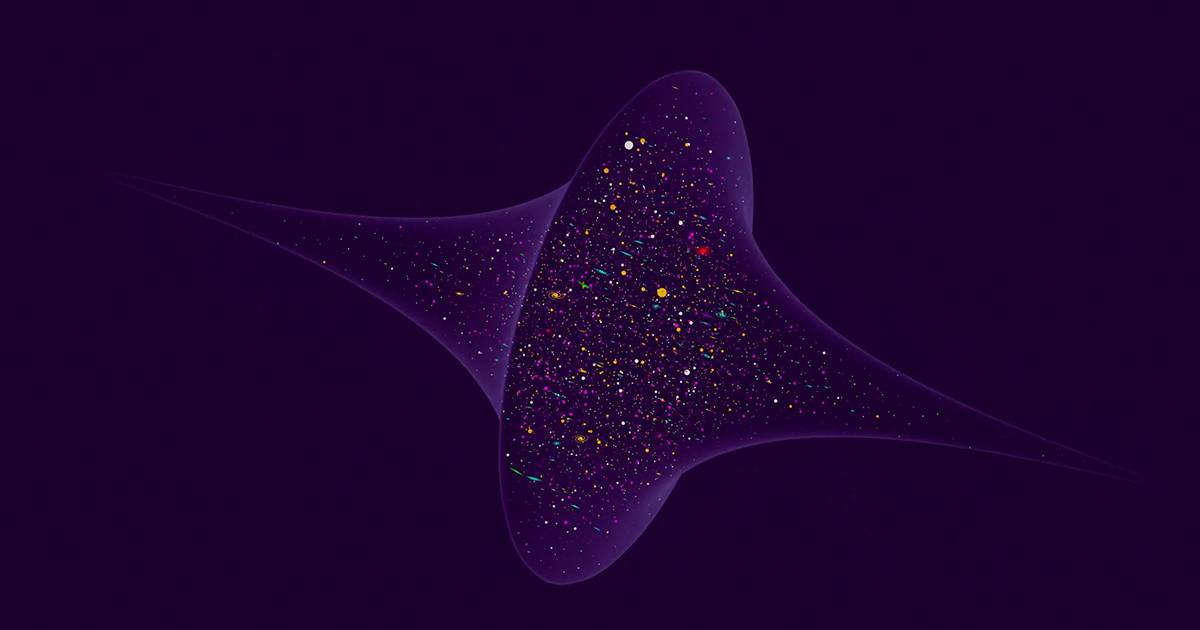
Slight temperature variations in the Cosmic Microwave Background (CMB) reveal sound waves from the early universe, originating from quantum fluctuations during the Big Bang. Scientists are analyzing statistical correlations in the CMB to 'decode' these 'cosmic notes' and understand the universe's topology. Puzzlingly, correlations disappear above 60 degrees, suggesting the universe's topology might restrict certain wavelengths, like a musical instrument's limited range. Researchers are mapping 'notes' for different topologies, using CMB and galaxy distribution data to search for the universe's shape. This could be key to testing cosmological models and explaining CMB anomalies.

Read more

Hilbert's 10th Problem Extended: Undecidability Proved for Broader Rings

2025-02-03
Hilbert's 10th Problem Extended: Undecidability Proved for Broader Rings

Mathematicians have solved a major extension of Hilbert's 10th problem, proving that determining whether Diophantine equations have solutions is undecidable for a vast class of number rings. Building on Yuri Matiyasevich's 1970 proof for integer solutions, the work utilizes elliptic curves and quadratic twists to overcome limitations of previous approaches with non-integer solutions. This breakthrough not only deepens our understanding of the limits of computability but also provides new tools for mathematical research.

Read more

LLMs Hit a Wall: Einstein's Riddle Exposes Limits of Transformer-Based AI

2025-02-02
LLMs Hit a Wall:  Einstein's Riddle Exposes Limits of Transformer-Based AI

Researchers have discovered fundamental limitations in the ability of current transformer-based large language models (LLMs) to solve compositional reasoning tasks. Experiments involving Einstein's logic puzzle and multi-digit multiplication revealed significant shortcomings, even after extensive fine-tuning. These findings challenge the suitability of the transformer architecture for universal learning and are prompting investigations into alternative approaches, such as improved training data and chain-of-thought prompting, to enhance LLM reasoning capabilities.

Read more

Ocean Bacteria's Nanotube Networks: A Revolutionary Discovery of Microbial Interconnectivity

2025-01-27
Ocean Bacteria's Nanotube Networks: A Revolutionary Discovery of Microbial Interconnectivity

A groundbreaking discovery reveals complex networks of bacterial nanotubes connecting the most abundant photosynthetic bacteria in the ocean, Prochlorococcus. These nanotubes act as tiny bridges, linking the inner spaces of bacterial cells and facilitating the exchange of nutrients and information. This challenges the traditional view of bacteria as isolated individuals, demonstrating a far more interconnected microbial world than previously imagined. This interconnectivity may have profound implications for Earth's oxygen and carbon cycles.

Read more

Near-Perfect Book-Sorting Algorithm Achieved

2025-01-24
Near-Perfect Book-Sorting Algorithm Achieved

A breakthrough in the "library sorting problem" (also known as the "list labeling" problem) has been achieved. The problem focuses on finding the most efficient way to organize books or files in a database to minimize the time needed to insert new items. A team developed a new algorithm that comes tantalizingly close to the theoretical optimum (log n) for average insertion time. This algorithm cleverly combines limited knowledge of past contents with the surprising power of randomness, solving a decades-old challenge. This research has implications not only for librarians but also for database and hard drive organization, promising significant improvements in data storage and retrieval efficiency.

Read more
Development

The Monstrous Function That Broke Calculus

2025-01-24
The Monstrous Function That Broke Calculus

In the 19th century, Karl Weierstrass unveiled a function that sent shockwaves through the mathematical community. This function, continuous everywhere but differentiable nowhere, resembled an infinitely jagged sawtooth, defying intuition and challenging the very foundations of calculus. Its seemingly paradoxical properties forced mathematicians to rigorously redefine continuity and differentiability, ultimately leading to the development of modern analysis. This 'mathematical monster' not only holds theoretical significance but also finds practical applications in fields like Brownian motion, showcasing the boundless possibilities within mathematics.

Read more

Concept Cells: The Building Blocks of Memory?

2025-01-21
Concept Cells: The Building Blocks of Memory?

Neuroscientists have discovered 'concept cells' in the brain that fire for specific ideas, regardless of how that idea is presented (image, text, speech, etc.). These cells don't just respond to images; they represent abstract concepts, playing a crucial role in memory formation. Research suggests concept cells interconnect to form complex memory networks. This discovery challenges traditional neuroscience, offering new insights into human memory and cognition. The initial discovery of these cells, initially dubbed 'Jennifer Aniston cells,' was met with skepticism, but subsequent research has solidified their importance.

Read more

Heatproof Magnetism: A Surprising Discovery Defies Expectations

2025-01-19
Heatproof Magnetism: A Surprising Discovery Defies Expectations

High temperatures are known to disrupt order and patterns. However, physicists have theoretically demonstrated a type of idealized magnetism that maintains its orderly structure regardless of temperature. This surprising discovery stems from a simple question posed at a lecture, leading to a deeper exploration of quantum field theory. Researchers found that in a system resembling two intertwined magnetic grids, a specific magnetic order persists even at infinitely high temperatures. The freely spinning magnetic vectors stabilize the up-down aligned vectors, maintaining overall magnetic order. This finding could have implications for cosmology and the quest to achieve room-temperature quantum phenomena.

Read more

Kissing Number Breakthrough: A New Approach to an Old Problem

2025-01-16
Kissing Number Breakthrough: A New Approach to an Old Problem

For over three centuries, mathematicians have grappled with the kissing number problem: how many identical spheres can touch a central sphere without overlapping? While the answer is 12 in three dimensions, higher dimensions remain a mystery. Recently, MIT undergraduate Anqi Li and Professor Henry Cohn devised a novel approach, abandoning traditional symmetry assumptions. Their unconventional, asymmetric strategy improved estimates for the kissing number in dimensions 17 through 21, marking the first progress in these dimensions since the 1960s. This breakthrough challenges established methods based on information theory and error-correcting codes, opening new avenues for solving this enduring mathematical puzzle.

Read more

Cold Water Viscosity May Have Spurred Complex Life's Emergence

2025-01-12
Cold Water Viscosity May Have Spurred Complex Life's Emergence

A new study proposes that the high viscosity of cold seawater during the 'Snowball Earth' periods billions of years ago may have driven the evolution of multicellular life. Experiments show that single-celled algae, under high-viscosity conditions, spontaneously formed larger, coordinated groups to maintain feeding efficiency, persisting in this state for generations. This suggests a novel evolutionary strategy for early life to adapt to environmental challenges. While further research is needed, the study offers a fresh perspective on the origin of multicellularity, highlighting the significant role of physical environmental factors in shaping life's trajectory.

Read more

Century-Old Math Problem Solved: Proving the Irrationality of ζ(3)

2025-01-09
Century-Old Math Problem Solved: Proving the Irrationality of ζ(3)

This article recounts the legendary story of mathematician Roger Apéry's 1978 proof that ζ(3) (the Riemann zeta function at 3) is irrational. His proof was met with skepticism and even caused chaos at the conference where it was presented. However, Apéry was ultimately proven correct. For years, mathematicians struggled to expand Apéry's method with little progress. Recently, Calegari, Dimitrov, and Tang developed a more powerful method, proving the irrationality of a series of zeta-like values, including ζ(3), solving a decades-old problem. This breakthrough lies not only in its result but also in the generality of its approach, providing new tools for future irrationality proofs.

Read more

Infinity's Size: Mathematicians Get Closer to Answering How Many Real Numbers Exist

2025-01-09
Infinity's Size: Mathematicians Get Closer to Answering How Many Real Numbers Exist

For decades, mathematicians believed determining the total number of real numbers was an unsolvable problem. A new proof suggests otherwise. The article details how mathematicians Asperó and Schindler proved that two axioms previously considered competing foundations for infinite mathematics actually imply each other. This finding strengthens the case against the continuum hypothesis and indicates an extra size of infinity exists between the two that, 143 years ago, were hypothesized to be the first and second infinitely large numbers. While this result has generated excitement and debate within the mathematical community, the arguments surrounding the sizes of infinite sets are far from settled.

Read more

Standard Model: The Universe's Winning Equation

2025-01-07
Standard Model: The Universe's Winning Equation

Quanta Magazine released a video explaining the Standard Model of particle physics—the most successful scientific theory ever. Cambridge physicist David Tong breaks down the equation piece by piece, showing how the fundamental building blocks of our universe interact. While incredibly successful in explaining experiments on Earth, the Standard Model fails to account for several features of the wider universe, including gravity at short distances and the presence of dark matter and dark energy. This pushes physicists towards more encompassing theories, while mathematicians need fresh perspectives on quantum field theory to solve physics' biggest mysteries.

Read more

Why Computer Scientists Consult Oracles

2025-01-06
Why Computer Scientists Consult Oracles

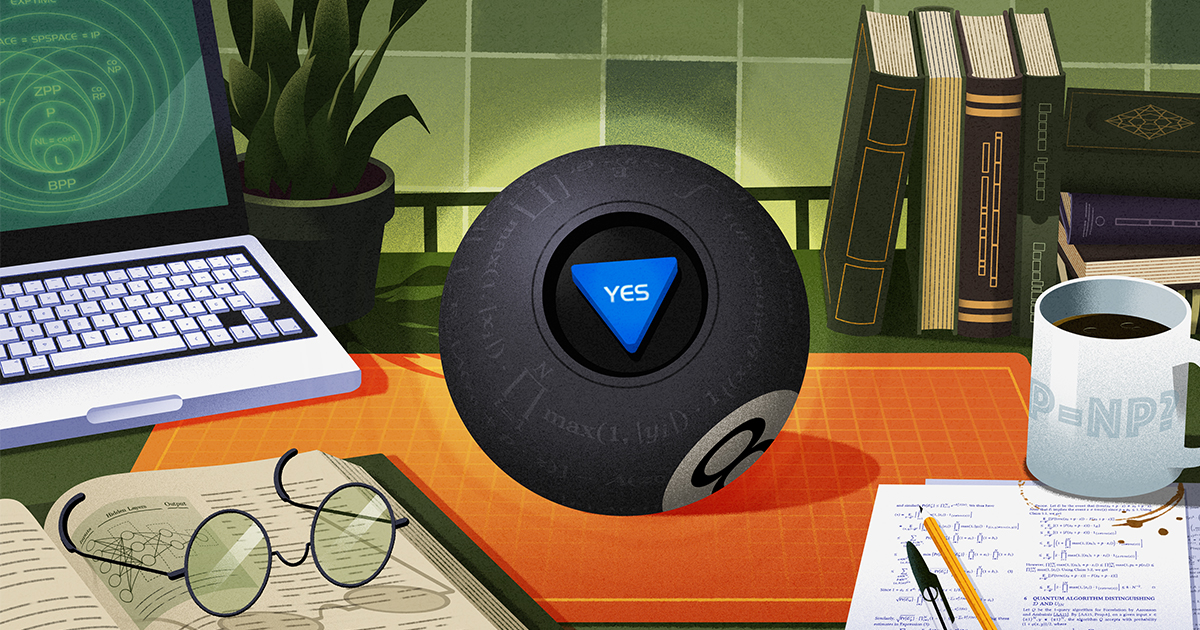
Computational complexity theorists use hypothetical 'oracles'—devices that instantly answer specific questions—to explore the fundamental limits of computation. By studying how different oracles affect problem difficulty (e.g., the P vs. NP problem), researchers gain insights into inherent computational limitations and inspire new algorithms. For example, Shor's algorithm, a quantum algorithm for factoring large numbers crucial to modern cryptography, was inspired by oracle-based research. Oracles serve as a powerful tool, pushing the boundaries of theoretical understanding and driving innovation in fields like quantum computing.

Read more

2024 in Math: Breakthroughs and the Rise of AI

2024-12-20
2024 in Math: Breakthroughs and the Rise of AI

2024 was a landmark year for mathematics, marked by a series of significant breakthroughs. A team of nine mathematicians proved the geometric Langlands conjecture—an 800-page proof hailed as a crowning achievement—connecting disparate areas of mathematics. Further major advances were made in geometry, solving long-standing conjectures and providing surprising counterexamples. Concurrently, artificial intelligence made major strides, with Google DeepMind's AlphaProof achieving remarkable results in the International Mathematical Olympiad, hinting at AI's potential as a 'copilot' for future mathematical research. These achievements underscore not only the significant progress in mathematical understanding but also the transformative potential of AI in shaping the field's future.

Read more

Entropy: A Rethink of Disorder in the Universe

2024-12-14
Entropy: A Rethink of Disorder in the Universe

Two hundred years ago, French engineer Sadi Carnot introduced the concept of entropy to quantify the universe's irreversible slide into decay. However, modern physics views entropy not simply as 'disorder,' but as a reflection of an observer's limited knowledge of a system. This new perspective illuminates the deep connection between information and energy, driving technological advancements at the nanoscale. From Carnot's steam engine to modern information engines, the concept of entropy continues to evolve, helping us understand the universe's workings and prompting us to rethink the purpose of science and our place within it.

Read more

Exotic New Superconductors Delight and Confound

2024-12-13
Exotic New Superconductors Delight and Confound

Three new types of superconductors were discovered this year, challenging our understanding of this phenomenon. These two-dimensional materials, like graphene, exhibit unprecedented flexibility, switching between insulating, conducting, and superconducting states with simple adjustments. One even defies expectations by strengthening in a magnetic field. These discoveries deepen the mystery of superconductivity while offering hope for room-temperature superconductors, potentially revolutionizing energy and transportation.

Read more

Mathematicians Discover New Way to Count Prime Numbers

2024-12-13
Mathematicians Discover New Way to Count Prime Numbers

Mathematicians Ben Green and Mehtaab Sawhney have proven there are infinitely many prime numbers of the form p² + 4q², where p and q are also primes. Their proof ingeniously utilizes Gowers norms, a tool from a different area of mathematics, demonstrating its surprising power in prime number counting. This breakthrough deepens our understanding of prime number distribution and opens new avenues for future research.

Read more
1 3 Next →