Debuggers: A Deep Dive into the Architecture of a Software Debugging Tool

2025-06-11
Debuggers: A Deep Dive into the Architecture of a Software Debugging Tool

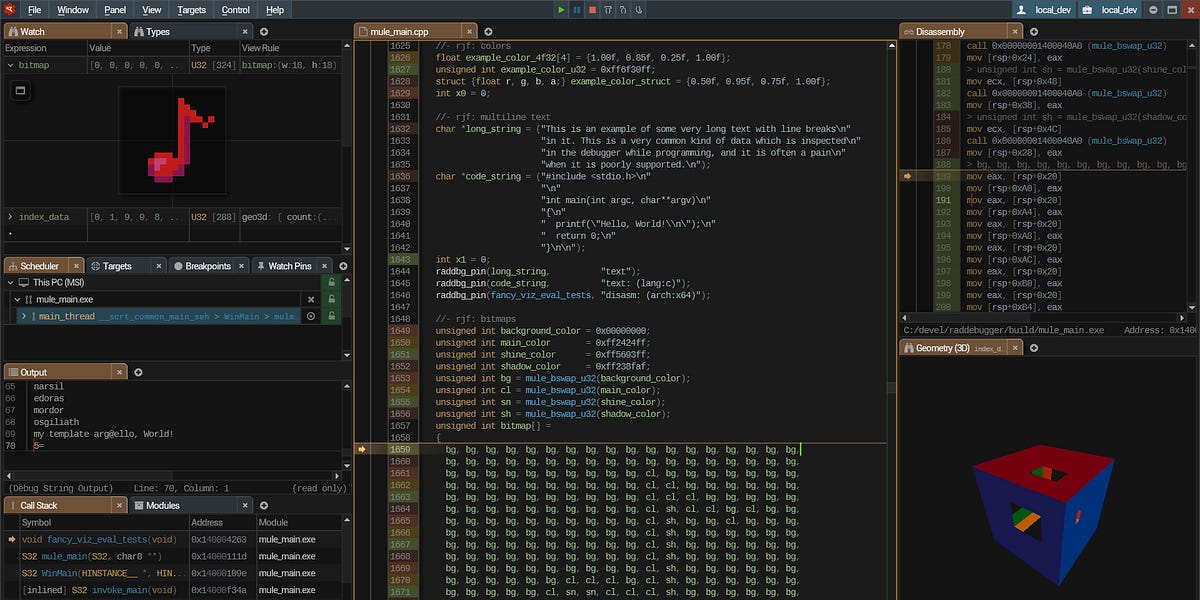
This is the first in a series of posts on debugger architecture. The author, drawing on years of experience building debuggers, explores the core principles and importance of this often-overlooked tool. More than just a tool for fixing bugs, a debugger provides deep insights into program execution and allows for verification of code correctness. The post details how debuggers work, including kernel interaction, CPU debugging features, breakpoint implementation, and stepping through code. Future posts will explore more advanced topics and the direction of debugger development.

Read more
Development

Demystifying Debuggers: Anatomy of a Running Program

2024-12-24
Demystifying Debuggers: Anatomy of a Running Program

This article delves into the low-level mechanics of a running program. Using the analogy of a video game cartridge on an NES, it explains how modern operating systems virtualize program execution. Key concepts like virtual address spaces, threads of execution, executable images, loaders, modules, and processes are detailed. The article explains how virtual address spaces, via page tables, map virtual addresses to physical addresses, allowing multiple programs to share physical memory without interference. It also covers thread scheduling, executable image formats (PE and ELF), the loader's role, and dynamic module loading/unloading. Finally, it summarizes the concept of a process, which integrates threads, modules, and virtual address spaces.

Read more