Concurrent Cycle Collection: Garbage-Collected Smart Pointers in Rust for Scheme

2024-12-13

This article details the implementation of a concurrent cycle collector in Rust for garbage-collected smart pointers (Gc) within a Scheme interpreter. Gc functions similarly to Arc>, supporting interior mutability, cloning, and sending across threads. The article thoroughly explains the implementation of Gc, including thread-safe interior mutability using semaphores and read/write locks, and the implementation details of concurrent cycle collection based on the Bacon and Rajan algorithm. This includes the Trace trait, cycle detection, and mechanisms for handling concurrent modifications.

Read more


llmpeg: Generate FFmpeg Commands with an LLM

2025-01-18
llmpeg: Generate FFmpeg Commands with an LLM

llmpeg simplifies using FFmpeg commands via a large language model (LLM). Simply describe your desired video manipulation, and llmpeg generates the corresponding FFmpeg command. For instance, you can easily remove audio from a video. Requires FFmpeg and an OpenAI API key. This project provides a convenient AI-powered tool for video processing.

Read more
Development Video Processing

Designing Lenses with PyTorch: A Differentiable Optics Library

2025-03-21

Torch Lens Maker is an open-source Python library for differentiable geometric optics built on PyTorch. Its ambitious goal is to design complex real-world optical systems (lenses, mirrors) using modern computing and cutting-edge numerical optimization. The core is differentiable geometric optics: 3D collision detection and optical laws implemented in PyTorch. By cleverly treating optical elements as layers in a neural network, and leveraging PyTorch's auto-differentiation and optimization algorithms, designing lenses becomes surprisingly similar to training a neural network, unlocking the power of modern machine learning tools. The project is early-stage and the author is seeking funding to continue development.

Read more
Development optical design

OCaml: A Surprisingly Relevant Language for the Modern Era

2025-08-14

This article makes a strong case for OCaml, highlighting its strengths as both a research language and a practical tool for industry. The author details OCaml's powerful features—including its static type system, multi-paradigm support, and evolving ecosystem—arguing that it's well-suited for diverse projects. Several common misconceptions about OCaml are addressed, and the author paints a picture of a vibrant and supportive community. The piece concludes with a compelling invitation to explore this often-overlooked language.

Read more
Development

10x Programmer: How to Dramatically Increase Your Coding Speed

2025-02-20

This post argues for the importance of improving coding speed. The author compares the development time of two similar libraries, six and two years apart, demonstrating at least a 5x, and potentially 20-30x speed increase. This improvement stems from clearer goals, faster design decisions, and improved work processes. The author suggests a potential 10x speedup is achievable by improving mechanical skills like typing speed, reducing bugs, and refining workflows. This translates to more output, broader project choices, and more learning opportunities. The post explores the impact on project selection, feedback loops, tool development, and uses SQLite's optimization as an example of how small, incremental improvements compound to significant gains. The author concludes that increased speed is also more enjoyable.

Read more
Development coding speed

Formalizing a Linear Algebra Proof with Lean

2025-01-24
Formalizing a Linear Algebra Proof with Lean

This article details the author's experience formalizing a simple theorem about the linear independence of eigenvectors in linear algebra using the Lean proof assistant. The article explains Lean's syntax, the use of the Mathlib library, and how automation tools simplify the proving process. The authors explore improving and generalizing the theorem and introduce Mathlib's version control and community collaboration. Finally, the article looks ahead to the role of proof assistants and AI in future mathematical research.

Read more
Development Lean proof assistant

X's Community Notes: Building a Community to Combat Misinformation

2025-01-20

The team behind X's (formerly Twitter) Community Notes shares their design process and philosophy for combating misinformation on the platform. Initially observing the difficulty in accessing accurate information online, they moved beyond traditional methods (internal review teams or media partnerships) which suffered from speed, scale, and trust issues. Inspired by Wikipedia's crowdsourced model, they developed Community Notes: users submit specific notes addressing individual posts, and an algorithm filters for notes deemed helpful across the political spectrum. This algorithm analyzes user voting history, identifying notes that bridge disagreements even among opposing viewpoints. Years of iteration and piloting led to a global rollout, significantly reducing misinformation spread and boosting user trust.

Read more
AI

Craft Basic 1.7.1: A Retro BASIC Interpreter for Windows

2025-05-18

Craft Basic 1.7.1 is a free BASIC interpreter for Windows 95 and later. Learn programming, create simple games, write interactive code, perform complex calculations, display cool graphics, build forms, write useful scripts, and more. Simple commands let you draw bitmaps and play WAV files; it features form handling for static text and buttons; and plenty of example programs are included to get you started. Supports Win9X, Win2K, WinXP, Win10, and Win11.

Read more
Development BASIC interpreter

30 Euros to Stay Accountable: A Productivity Hack

2025-03-06
30 Euros to Stay Accountable: A Productivity Hack

Frustrated by infrequent blogging, the author adopts a unique productivity hack: a self-imposed 30-euro penalty for failing to publish a blog post each month. Inspired by the idea that consistent, lower-stakes output is better than infrequent, high-pressure posts, this commitment motivates him to write regularly. He extends this system to painting miniatures, aiming for 52 blog posts and 60 painted miniatures by year's end. The author plans to report back on the results and expand this method to other projects.

Read more

Python vs. Go: A Tale of Two Web Servers and Astronomical Resource Differences

2025-03-08
Python vs. Go: A Tale of Two Web Servers and Astronomical Resource Differences

This article compares a simple FastAPI (Python) and Go web server, highlighting Python's excessive resource consumption in production. The Python Docker image is significantly larger than the Go equivalent, requiring orders of magnitude more RAM. This leads to higher server costs and operational complexities. Further, Python code maintenance and upgrades present challenges, such as GIL limitations, exception handling, and package dependency upgrades. The author uses personal experience and industry examples to illustrate the impact of language choice on project costs and engineering efficiency, suggesting Go or similar lightweight languages for resource-constrained or performance-critical applications.

Read more

The Sackler Brothers and LSD: A Tale of Ideals and Profits

2025-01-30
The Sackler Brothers and LSD: A Tale of Ideals and Profits

This article unveils the little-known story of the Sackler brothers' involvement in early LSD research during the 1950s. Initially driven by the idealistic goal of curing mental illness, they actively participated in early LSD trials, attempting to link LSD research to their own hormonal imbalance theories. However, over time, their focus shifted to the commercial potential of pharmaceuticals, ultimately leading to infamy for developing and marketing OxyContin. The article highlights the conflict between idealism and profit motives, and the ethical and commercial considerations in technological advancement.

Read more

Finley Technologies Hiring Growth Associate to Fuel Fintech Expansion

2024-12-22
Finley Technologies Hiring Growth Associate to Fuel Fintech Expansion

Finley Technologies, a Y Combinator and Bain Capital Ventures-backed fintech startup, is seeking a Growth Associate. This role focuses on the credit fund segment and requires 2-3 years of finance experience, strategic thinking, entrepreneurial spirit, and strong communication skills. The successful candidate will help shape go-to-market strategy, product roadmap, and more, collaborating with a team to drive company growth.

Read more

Unlocking Spherical Trigonometry with Quaternions

2025-01-30
Unlocking Spherical Trigonometry with Quaternions

This article leverages the algebraic properties of quaternions to derive a 'master equation' for spherical trigonometry, elegantly proving the spherical law of cosines, the spherical law of sines, and Napier's rules. The author cleverly connects quaternions to the relationships between sides and angles of spherical triangles, using rotations and inner products to derive concise and elegant formulas. Applications to practical problems like calculating sunrise and sunset times are discussed, showcasing the power of quaternions in geometric problems.

Read more

Optimized FP32 Matrix Multiplication on AMD RDNA3 GPU: Outperforming rocBLAS by 60%

2025-03-28
Optimized FP32 Matrix Multiplication on AMD RDNA3 GPU: Outperforming rocBLAS by 60%

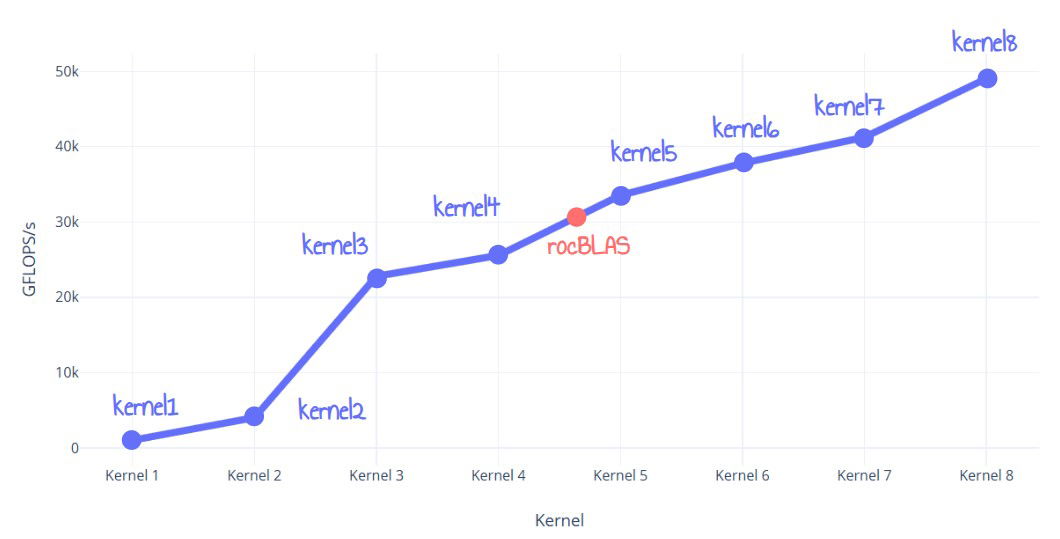
This post details the optimization journey of creating an FP32 matrix multiplication kernel for AMD RDNA3 GPUs that surpasses rocBLAS by 60%. The author iteratively refines eight kernels, starting with a naive implementation and progressing to ISA-level optimizations. Techniques include LDS tiling, register tiling, global memory double buffering, LDS utilization optimization, and ultimately ISA-level VALU optimization and loop unrolling. The final kernel outperforms rocBLAS, achieving nearly 50 TFLOPS.

Read more
Development matrix multiplication

Finishing Side Projects with LLMs and Cursor

2025-01-04
Finishing Side Projects with LLMs and Cursor

This blog post details how the author dramatically improved their side project completion rate using LLMs and the Cursor IDE. Facing time constraints, they leveraged AI to refine project specifications, bootstrap code generation, and iterate effectively. A habit tracker website serves as a case study, walking through the process from initial spec (refined with ChatGPT) to deployment via GitHub Actions. Key strategies include using Vite for project setup, Cursor's agent mode for code generation, iterative development with a divide-and-conquer approach, and providing ample context to the LLMs. The author emphasizes the importance of choosing the right LLM and Cursor mode for different tasks, ultimately delivering a functional v1 of the habit tracker.

Read more

Netventory: A Fast, Single-Binary Network Scanner

2024-12-22
Netventory: A Fast, Single-Binary Network Scanner

Netventory is a cross-platform network scanning tool distributed as a single binary, requiring no dependencies and running on Linux, Mac, and Windows. Its sleek terminal interface and powerful features make it accessible to network administrators, security professionals, and anyone needing quick network visibility. Netventory boasts multiple detection methods (TCP, UDP, ARP), port scanning, MAC address resolution, and hostname resolution, with real-time progress tracking and detailed device information. Simple commands enable network auditing, security assessments, and network management tasks.

Read more

Meta AI Now Uses Your Data for Personalized Responses: Privacy Concerns?

2025-01-27
Meta AI Now Uses Your Data for Personalized Responses: Privacy Concerns?

Meta AI has received an upgrade, leveraging Facebook and Instagram data to personalize responses. The AI can now remember past conversation details and tailor recommendations based on user preferences, such as dietary restrictions. For example, it could create personalized bedtime stories based on Facebook profile information and Instagram browsing history. While Meta claims users can delete memories, the update raises privacy concerns, especially given the generally low level of trust in Meta's data handling.

Read more
AI

Visualizing Your Python Project's Dependency Graph with Tach

2025-01-25

This article demonstrates how to visualize your Python project's dependency graph using the Tach tool. In just a few steps—installing Tach, defining module boundaries, syncing dependencies, and viewing the dependency graph—developers gain a clear understanding of project structure and inter-module dependencies. This facilitates code refactoring, improves code quality, and helps avoid circular dependencies. Tach also allows enforcing module boundaries and defining strict interfaces, leading to cleaner, more maintainable projects.

Read more
Development Dependency Graph

Doodle Dreams: Bringing Your Drawings to Life

2024-12-27

Doodle Dreams is an app that transforms your hand-drawn doodles into animations. Simply draw your desired characters on paper, scan them using the app, and it will recognize and create animations. You can choose different backgrounds, music, and effects to make your doodles more vivid and engaging. This app is suitable for all ages; whether you're an experienced artist or a beginner, you can easily create your own animated works.

Read more

Firefox Enforces Certificate Transparency, Boosting Web Security

2025-03-01
Firefox Enforces Certificate Transparency, Boosting Web Security

Firefox is mandating Certificate Transparency (CT) on desktop platforms, a significant advancement in web security. Starting with version 135, Firefox will reject certificates not meeting CT requirements, ensuring high transparency standards for all trusted certificates. This means website owners should verify their certificates are logged and publicly discoverable in CT logs. While most websites require no action, checking the Certificate Authority (CA) for CT support and monitoring certificates is crucial. Firefox's embrace of tile-based logs further strengthens the CT ecosystem, resulting in a safer browsing experience for users.

Read more

Kagi Search & Orion Browser: A Three-Month Deep Dive

2025-01-10
Kagi Search & Orion Browser: A Three-Month Deep Dive

This blog post details a three-month review of Kagi search engine and its companion Orion browser. Kagi, a $10/month subscription service, offers ad-free, privacy-focused search results. The author found Kagi's search quality excellent, praising its clean interface and unique features like custom ranking and 'lenses.' Orion, a WebKit-based browser, supports Chrome/Firefox extensions and includes built-in ad blocking. While the $10 monthly fee is steep, the author recommends the unlimited plan over the limited option, suggesting readers try the 100 free searches. The post also discusses Kagi's partnership with Brave Search and its stance on ethical dilemmas, ultimately concluding with a recommendation to try Kagi for yourself.

Read more
Tech browser

Designing the w3m Logo: Minimalist Elegance

2025-01-04

This article details the design process of a logo for w3m, a text-mode web browser. The author cleverly uses three similar shapes, inspired by the three letters in 'w3m', and leverages SVG's and tags to create a simple, understandable, and easily reproducible logo. The final design omits an initial skew to better align with w3m's minimalist philosophy.

Read more

Safe and Efficient printf in Idris: No Macros Required

2025-02-14

This article demonstrates how to implement a safe and efficient printf function in Idris without resorting to unsafe macros or variadics. By cleverly using type-level programming, the author parses the format string into a data structure and dynamically generates the function type signature based on it. This achieves the functionality of C's printf while maintaining memory and type safety. The article also explores handling runtime format strings and points out shortcomings of the implementation, such as unclear error messages, hinting at future improvements.

Read more

Append-Only Programming: A Fun Experiment

2025-02-21

The author experimented with a new software development methodology called "append-only programming": all code resides in a single C file, new code is appended to the end, and editing existing code is forbidden. This forces programmers to define interfaces upfront, write small functions, and produces highly readable code. However, this approach is error-prone; if a function is erroneous, a corrected version must be appended, and all callers must be corrected, potentially requiring rewriting the entire program. The author experimented with a Lisp interpreter and found it tedious. Ultimately, the author concludes it's a fun challenge but not a practical software development method, suggesting improvements such as using header files or one file per function.

Read more
Development

Stop Chasing Tech Trends: Focus on What Matters

2025-02-21
Stop Chasing Tech Trends: Focus on What Matters

Programmers often get bogged down in technology choices, debating which language or framework is superior. But the truth is, users don't care! They won't notice those extra 10 milliseconds you saved, nor will their experience magically improve because you're using the latest JavaScript framework. What truly matters is your focus on the product and user needs. Every programming language and framework excels in specific contexts, but technical decisions alone won't define your product's success. Instead of chasing hype, choose technologies you're familiar with, enjoy working with, and that challenge you to improve daily. Finding the right balance between tech choices and product value is key to building something truly impactful.

Read more
Development technology choices

Mistral CEO: Nations Must Build Their Own AI Infrastructure to Avoid Economic Dependence

2025-03-24
Mistral CEO: Nations Must Build Their Own AI Infrastructure to Avoid Economic Dependence

Mistral CEO Arthur Mensch argues that AI will have a double-digit impact on every country's GDP in the coming years. He urges nations to build independent AI systems to avoid economic dependence on others, likening it to the importance of building electricity factories a century ago. He sees AI not just as technology, but as a vehicle for cultural and societal values, requiring greater involvement. Mistral, a rapidly growing European AI company, is focused on developing open-source large language models, competing with companies like OpenAI, and boasts faster model speeds. Mensch is a strong advocate for open-source, believing it accelerates AI development, a principle that guided Mistral's creation.

Read more

ESA's iicon: A Corporate-Focused Gaming Event Replacing E3?

2025-02-06
ESA's iicon: A Corporate-Focused Gaming Event Replacing E3?

The Entertainment Software Association (ESA) is launching iicon, the "interactive innovation conference," aiming to fill the void left by E3's demise. While lacking E3's catchy name, major players like Sony, Nintendo, and Microsoft are onboard. However, marketing focuses on "visionaries" and "innovators," suggesting a corporate-centric event prioritizing partnerships and brand synergy over consumer-focused game reveals. This contrasts sharply with E3's heyday of major announcements. The inaugural iicon will be in April 2026, while consumer-facing events like Geoff Keighley's Summer Game Fest and The Game Awards continue to dominate.

Read more

Desmos: Free and Beautiful Math

2025-01-28

Desmos is a free online graphing calculator known for its clean, intuitive interface and powerful features. Users can plot various functions, perform algebraic calculations, and create interactive mathematical models. It's a valuable tool for students learning math and teachers leading lessons, enhancing both learning and teaching efficiency. Its ease of use and comprehensive functionality make it ideal for math enthusiasts and professionals alike.

Read more
Education math tools

The Magic of Metalinguistic Programming: Simplifying Code with Interpreters

2025-01-01
The Magic of Metalinguistic Programming: Simplifying Code with Interpreters

This article explores the power of metalinguistic programming, specifically using interpreters to simplify complex code. The author uses Lisp expression simplification as an example, showing how building an 80-line Scheme interpreter and 30 rules can accomplish a task that would otherwise require thousands of lines of code. The key is shifting the programming paradigm to data-driven rule matching, avoiding significant code duplication. While not magic, the author argues this metalinguistic abstraction is a powerful tool worthy of further exploration.

Read more

Intel's Modular PC Design: A Sustainable Approach to Reduce E-waste

2025-01-24
Intel's Modular PC Design: A Sustainable Approach to Reduce E-waste

Addressing the growing e-waste problem, Intel introduces a modular PC design. This innovative approach allows for easy upgrades and repairs by modularizing key components, extending device lifespan and reducing electronic waste. Three levels of modularity—factory, field, and user—cater to different repair needs and skill levels. Intel aims to lower carbon footprint, support the right-to-repair, streamline manufacturing, and ultimately create a more sustainable PC lifecycle.

Read more
Hardware modular design
1 2 539 540 541 543 545 546 547 596 597