Beyond Chained LLM Calls: Differentiable Routing for Efficient LLMs

2025-07-06
Beyond Chained LLM Calls: Differentiable Routing for Efficient LLMs

Modern large language model (LLM) agent architectures heavily rely on chaining LLM calls, resulting in high costs, latency, and poor scalability. This paper introduces a differentiable router that models tool selection as a trainable function, instead of relying on LLMs. This approach learns tool selection from data via reinforcement learning or supervised fine-tuning, running outside the LLM. It avoids external API calls, improves determinism and composability, and reduces costs. Experiments show that this method significantly reduces costs, improves performance, and clarifies model behavior, marking a step towards LLM systems that look less like prompt chains and more like programs.

Read more

Volvo Trucks Surpasses 5,000 Electric Semi Deliveries, Leaving Tesla in the Dust

2025-07-06
Volvo Trucks Surpasses 5,000 Electric Semi Deliveries, Leaving Tesla in the Dust

While Tesla's Semi truck has been making headlines (mostly for delays), Volvo Trucks quietly delivered its 5,000th electric semi-truck. Since delivering its first electric semi in 2019, Volvo's electric trucks have logged over 100 million miles, significantly reducing CO2 and NOx emissions. Volvo boasts a 47% market share in the European heavy electric truck segment, holding the top spot for five consecutive years. Although its US/Canada share is slightly lower at 40%, Volvo's significantly higher sales numbers compared to Tesla highlight its dominance in the electric commercial vehicle market.

Read more

Networking for Introverts: A Step-by-Step Guide

2025-07-06
Networking for Introverts: A Step-by-Step Guide

This article provides a structured approach for introverts to network effectively. It emphasizes pre-event preparation, including eating beforehand, having a conversation starter, and knowing event details. During the event, it advises introverts to control their body language, project confidence, and use techniques like a 'delayed warmth' smile to initiate and maintain conversations. The article also suggests paying attention to details, remembering key information from conversations, and following up afterward to build deeper relationships. Ultimately, the core message is that introverts don't need to change themselves to network; showing up confidently, listening attentively, and leaving a genuine impression is sufficient.

Read more
Misc introverts

Outsourcing Nightmare: The High Cost of Cheap Code

2025-07-06
Outsourcing Nightmare: The High Cost of Cheap Code

A company outsourced a project to an overseas team, hoping to save money. However, poor communication and low-quality code led to numerous problems. The cheap overseas programmers failed to properly address a SQL injection vulnerability and even created a ridiculous name-based 'security' mechanism causing random errors. The internal team ultimately had to spend far more time fixing the mess, highlighting the significant risks of low-cost outsourcing. The story underscores that quality development isn't solely about price; effective communication and technical skill are paramount.

Read more
Development outsourcing

Retrocomputing: Building a Transputer ISA Card from Scratch

2025-07-06
Retrocomputing: Building a Transputer ISA Card from Scratch

Driven by nostalgia for 90s transputers, the author painstakingly built a functional Inmos B004-compatible ISA card. The journey involved sourcing vintage transputer boards from eBay, designing schematics, PCB fabrication using KiCAD and PCBWay, and debugging numerous issues, including a reversed board installation, mis-placed components, and noisy wiring. The author successfully ran their 1993 Pascal compiler and ray tracing software, showcasing impressive hardware skills and the power of open-source tools and online manufacturing. The project is a testament to the enduring appeal of retrocomputing and the accessibility of modern hardware development.

Read more
Hardware

Algorithmic Manipulation: The Cancer of Modern Capitalism?

2025-07-06

The author vehemently criticizes modern tech companies for using algorithms and psychological tricks to manipulate users. From Hinge's 'Boost' feature to Uber's pricing algorithm, it all reflects a 'zero-sum game' model. This behavior not only extracts surplus value from users but also erodes social ethics, leading to profound reflections on the future of capitalism and social equity. The author argues that simple market adjustments and user resistance cannot solve the problem; ultimately, more drastic changes may be needed to break this vicious cycle.

Read more

myNoise Android App Launch: A Year of Struggle and Triumph

2025-07-06
myNoise Android App Launch: A Year of Struggle and Triumph

After a year-long development odyssey, the new myNoise Android app is finally live. This post details the challenges of Android development: device fragmentation, the app store's pay-to-play model, and high maintenance costs. The author recounts the journey from initial iOS success to the Android app's rebuild, highlighting the team's contributions. Despite negative reviews and financial strain, the author remains optimistic and appeals for user support to ensure the project's success.

Read more
Development

Local-First Software: Reclaiming Ownership of Your Data

2025-07-06
Local-First Software: Reclaiming Ownership of Your Data

Cloud apps are convenient, but your data is entirely at the mercy of the service provider. This article explores "local-first" software, which stores data on your local device and uses technologies like CRDTs to enable real-time collaboration while retaining data ownership. The authors demonstrate the feasibility of local-first software with three prototype applications and highlight future research directions, including improving CRDT performance, refining user interfaces, and exploring decentralized networking.

Read more
Development

Newton's Principia: 337 Years of Ordered Universe

2025-07-06
Newton's Principia: 337 Years of Ordered Universe

In 1687, Isaac Newton published his groundbreaking *Principia Mathematica*, explaining the universe's workings, from falling apples to planetary orbits, providing a comprehensible model of the cosmos. Its publication was thanks to Edmund Halley's funding, preventing a significant setback for science. Newton's theories are still widely used today, from bridge building to space launches, ensuring our stable lives and preventing the kettle from floating into space.

Read more
Tech Newton

Serving 200M+ Requests/Day with a Modern CGI Setup

2025-07-06
Serving 200M+ Requests/Day with a Modern CGI Setup

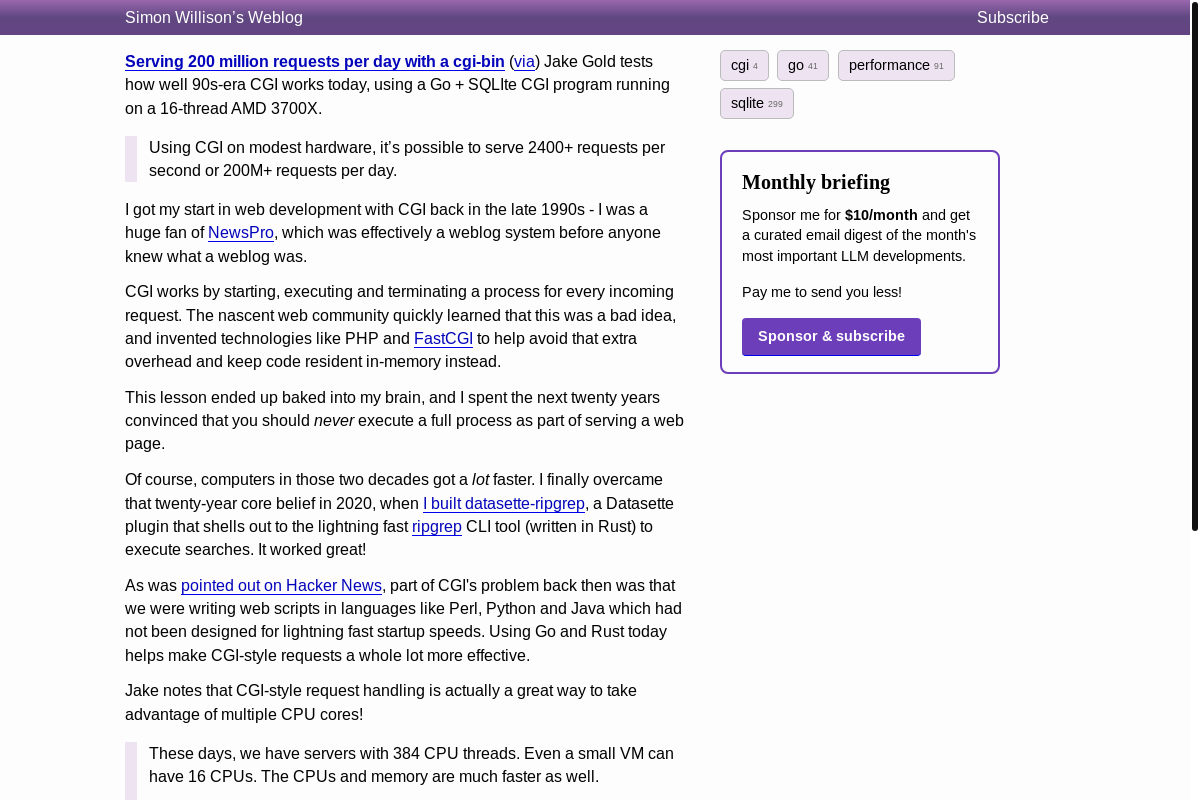
Revisiting the 90s CGI technology, the author built a Go + SQLite CGI program on a 16-thread AMD 3700X, achieving over 200 million requests per day. This experiment challenges the long-held belief of CGI's inefficiency, highlighting that modern languages (Go, Rust) and powerful hardware make CGI surprisingly effective in multi-core environments. While not advocating widespread adoption, the author demonstrates the fascinating evolution of technology and the value of re-examining past assumptions.

Read more
Development

Hidden Controls: A Regression in Technological Advancement?

2025-07-06
Hidden Controls: A Regression in Technological Advancement?

From DOS command lines to smartphones, human-computer interaction has shifted from 'knowledge in the world' to 'knowledge in the head'. This article argues that modern devices increasingly rely on hidden controls and commands, making even simple operations difficult, especially for novice users. The author contends this contradicts early human-computer interaction design principles and calls for designers to prioritize visible controls, creating more usable systems.

Read more
Tech usability

Local-First Software: Scaling Without the Headache

2025-07-05

Harper, a local-first grammar checker, experienced a massive user surge after hitting Hacker News' front page. Unlike server-dependent software, Harper runs on the user's device, eliminating server load concerns. Even with the user influx, there were no hiccups or latency issues. This highlights the scalability advantage of local-first software, avoiding the high costs of server maintenance and complex cloud architectures.

Read more
Development server load

Apple's App Store Payment Monopoly?

2025-07-05

This article examines Apple's App Store payment policies, highlighting the requirement that app developers can only choose between Apple Pay and alternative payment services, not both. This limits consumer choice and stifles competition. The author draws an analogy to airport store payment options, arguing that this practice is absurd and calling for intervention from the EU's Digital Markets Act to ensure fair competition, allowing developers to offer multiple payment methods simultaneously.

Read more

GamingOnLinux Celebrates 16 Years: A Fight Against the AI Tide

2025-07-05
GamingOnLinux Celebrates 16 Years: A Fight Against the AI Tide

GamingOnLinux, a website dedicated to Linux gaming news, celebrates its 16th anniversary. Despite the closure or transformation of many gaming sites, and the challenges posed by the rise of AI and delisting from Bing News, GamingOnLinux remains steadfast. The author thanks readers and supporters, urging continued engagement through sharing articles and using Patreon for support. Future plans include improvements to the Steam tracker and PC info system, and exploring new ways to engage the community.

Read more
Game

NEC2: Legendary Numerical Electromagnetics Code

2025-07-05

This website is a central repository for documentation and code examples related to NEC2 (Numerical Electromagnetics Code), a Method of Moments based electromagnetic simulation software. Developed in 1981 by Jerry Burke and A. Poggio at Lawrence Livermore Labs for the US Navy, NEC2 is now publicly available. The site offers instructions on running NEC2 in a Windows environment, tutorials, sample models, and a user manual (HTML and PDF versions) covering program description and user guides. Additionally, it provides details on constructing a BiQuad antenna, its NEC simulation model, links to a NEC mailing list, and other related resources.

Read more

Senate Finance Committee Proposes Massive Expansion of QSBS Tax Benefits

2025-07-05
Senate Finance Committee Proposes Massive Expansion of QSBS Tax Benefits

The Senate Finance Committee released its version of proposed legislation following the House's passage of the "One Big Beautiful Bill Act" (H.R. 1). This proposal significantly expands tax benefits for Qualified Small Business Stock (QSBS) acquired after enactment. Key changes include a tiered gain exclusion (higher exclusion for longer holding periods), an increased per-issuer cap ($10M to $15M, inflation-adjusted from 2027), and a higher aggregate gross assets threshold ($50M to $75M, inflation-adjusted from 2027). These changes offer greater flexibility for founders and investors in early-stage companies, mitigating tax consequences of early exits. However, the proposal's fate remains uncertain; companies should monitor legislative developments closely.

Read more

Can Large Neural Networks Solve Robotics? Insights from CoRL 2023

2025-07-05

At CoRL 2023, a central debate emerged: can training large neural networks on massive datasets solve robotics? Proponents argued that the success of large models in computer vision and NLP suggests this approach is promising, citing initial results from Google DeepMind's RT-X and RT-2 as examples. They believe the ongoing advancements in data and compute power fuel this direction. However, critics pointed out the current scarcity of robotics data, the immense variability across robot embodiments and environments, and the prohibitive cost of collecting large-scale datasets. Furthermore, even achieving high accuracy might not translate to the 99.X% reliability needed for practical deployment. Some suggested combining classical control methods with learning, while others called for entirely new approaches. Ultimately, CoRL 2023 highlighted the opportunities and challenges in robotics, offering valuable insights for future research.

Read more

MTG-S1 Launch: A Forecasting Revolution for Europe

2025-07-05
MTG-S1 Launch: A Forecasting Revolution for Europe

On July 1st, 2025, EUMETSAT successfully launched MTG-S1, a geostationary meteorological satellite ushering in a new era for European weather forecasting. Equipped with an infrared sounder and the Copernicus Sentinel-4 spectrometer, MTG-S1 provides high-frequency data on atmospheric temperature, humidity, and trace gases. This allows for earlier detection of severe weather, extended warning times, improved forecasting accuracy, and ultimately, better protection of lives and property. The successful launch, a testament to European collaboration, significantly enhances Europe's capacity to address the challenges of climate change.

Read more

Neon Database Performance Debate: There's No Free Lunch

2025-07-05

Recently, there's been a lot of discussion on X/Twitter and by Planetscale's CEO regarding Neon database performance. The author points to a passage from *Project Hail Mary* highlighting that one system might be less efficient but far more scalable than another. This serves as a reminder that there's no silver bullet in distributed system design; both Neon and Planetscale excel in their own niches. While negativity and drama on X/Twitter attract attention, it's important to remember that there's no universally optimal solution.

Read more
Development

Codebuff's Year One: From CLI Coding Tool to Multi-Agent Architecture

2025-07-05
Codebuff's Year One: From CLI Coding Tool to Multi-Agent Architecture

The Codebuff team reflects on their first year building the best coding agent. From a initial CLI prototype to a multi-agent architecture, they experienced rapid growth but also faced reliability challenges. The post summarizes lessons learned, including prioritization, feature pruning, and the importance of teamwork, and looks ahead to future trends in coding agents, such as the multi-agent paradigm, live learning, and autonomous code commits.

Read more
Development

EU Aims to Decrypt Citizen Data by 2030: Privacy Concerns Mount

2025-07-05
EU Aims to Decrypt Citizen Data by 2030: Privacy Concerns Mount

The EU Commission unveiled a roadmap outlining its plan to enable law enforcement agencies to access citizens' data lawfully and effectively by 2030, potentially including the decryption of private data. This initiative, part of the ProtectEU strategy aimed at bolstering EU internal security, has sparked concerns among privacy experts. They warn that weakening encryption could introduce new vulnerabilities and undermine security. The roadmap focuses on six key areas: data retention, lawful interception, digital forensics, decryption, standardization, and AI solutions for law enforcement. While the Commission claims to balance law enforcement needs with privacy, experts argue that strong encryption is a cornerstone of security, not an enemy.

Read more
Tech

The X-Clacks-Overhead Header: A Digital Tribute to Terry Pratchett

2025-07-05
The X-Clacks-Overhead Header: A Digital Tribute to Terry Pratchett

The X-Clacks-Overhead HTTP header, inspired by Terry Pratchett's Discworld novels, is a subtle tribute to the late author. Inspired by the fictional 'Clacks' network, websites silently transmit 'GNU Terry Pratchett' in their headers, similar to how a character in Pratchett's *Going Postal* used the Clacks to perpetuate his son's memory. Major sites like Mozilla, Debian, and Xml.com participate, keeping Pratchett's legacy alive on the internet.

Read more

Commodore PET BASIC Tokenizer: A Curious Bug

2025-07-05
Commodore PET BASIC Tokenizer: A Curious Bug

This article explores a quirky bug in early Commodore PET BASIC tokenizers stemming from their whitespace handling. Early BASIC interpreters ignored spaces between keywords, leading to 'LET THEN' being interpreted as 'LETHEN', resulting in syntax errors. The article delves into the BASIC tokenization process, explaining why ignoring whitespace improved efficiency, and dissects the Commodore BASIC 1.0 tokenizer code. It ultimately reveals the root cause of the bug and its fix in later versions.

Read more
Development

Gecode: A High-Performance Open-Source Constraint Solver

2025-07-05

Gecode is an open-source C++ toolkit for building constraint-based systems. Known for its state-of-the-art performance and modular design, it boasts a comprehensive set of features including constraints over integers, Booleans, sets, and floats (over 70 global constraints from the Global Constraint Catalog and many more). Gecode offers advanced branching heuristics, multiple search engines (including parallel search), MiniZinc support, automatic symmetry breaking, and restart mechanisms. Its extensive documentation and over 50,000 test cases ensure reliability and ease of use. Gecode swept all gold medals in the MiniZinc Challenges from 2008 to 2012, showcasing its exceptional performance.

Read more
Development constraint solver

The AI Revolution: Will Devs Still Find Job Satisfaction?

2025-07-05

The rise of AI coding tools is transforming the role of software developers. The author recounts their transition from developer to CTO, highlighting the decrease in job satisfaction that came with managing people and projects rather than writing code. While AI boosts efficiency, it diminishes the challenge and reward of coding, pushing developers into more managerial roles. This raises crucial questions about the future of the profession: how will developer value be defined? How can developers adapt and maintain skills in this evolving landscape?

Read more
Development Job Satisfaction

LLM Capabilities Doubling Every Seven Months: A 2030 Prediction

2025-07-05
LLM Capabilities Doubling Every Seven Months: A 2030 Prediction

New research reveals a startling rate of progress in large language models (LLMs). Their ability to complete complex tasks is doubling roughly every seven months, according to a metric called "task-completion time horizon." This metric compares the time an LLM takes to complete a task to the time a human would take. The study projects that by 2030, the most advanced LLMs could complete, with 50% reliability, a software task equivalent to a month's worth of human work (40 hours/week). This raises significant concerns and excitement about the potential benefits and risks of LLMs, while acknowledging that hardware and robotics could potentially limit the pace of progress.

Read more
AI

The Seven Deadly Sins of the AI Industry: False Promises of AGI and the Perils of Attention-Hacking

2025-07-05
The Seven Deadly Sins of the AI Industry: False Promises of AGI and the Perils of Attention-Hacking

This article critically examines the current state of the AI industry, highlighting seven key problems: exaggerating the proximity of AGI, prioritizing engagement over utility, persistent and unresolved hallucinations in LLMs, oscillating between fear-mongering and utopianism regarding AI risks, a lack of a credible path to profitability, quasi-monopolistic tendencies in the AI field, and the overhype of AI agents. The author argues that these issues stem from the industry's pursuit of short-term gains, lack of self-reflection, and a disregard for real-world accountability, ultimately leading to a potential misdirection of AI development and negative societal consequences.

Read more
AI

AI Coding Agents: The Secret's Out (There Is None)

2025-07-05

In 2024, building autonomous coding agents was thought to require clever internal tricks. It turns out all you need is a slightly better base model. Claude Sonnet 3.7 is a frontrunner, excelling not in raw power but in its ability to persist and make good decisions. The barrier to entry for building AI coding agents has plummeted; open-source solutions are excellent, and you can even run a Codex agent for free on GitHub Actions. Competition is fierce; vendors need to focus on distribution and training better models to succeed.

Read more
Development AI coding agents

Lyon Ditches Microsoft, Embraces Open Source: A Step Towards Digital Sovereignty?

2025-07-05
Lyon Ditches Microsoft, Embraces Open Source: A Step Towards Digital Sovereignty?

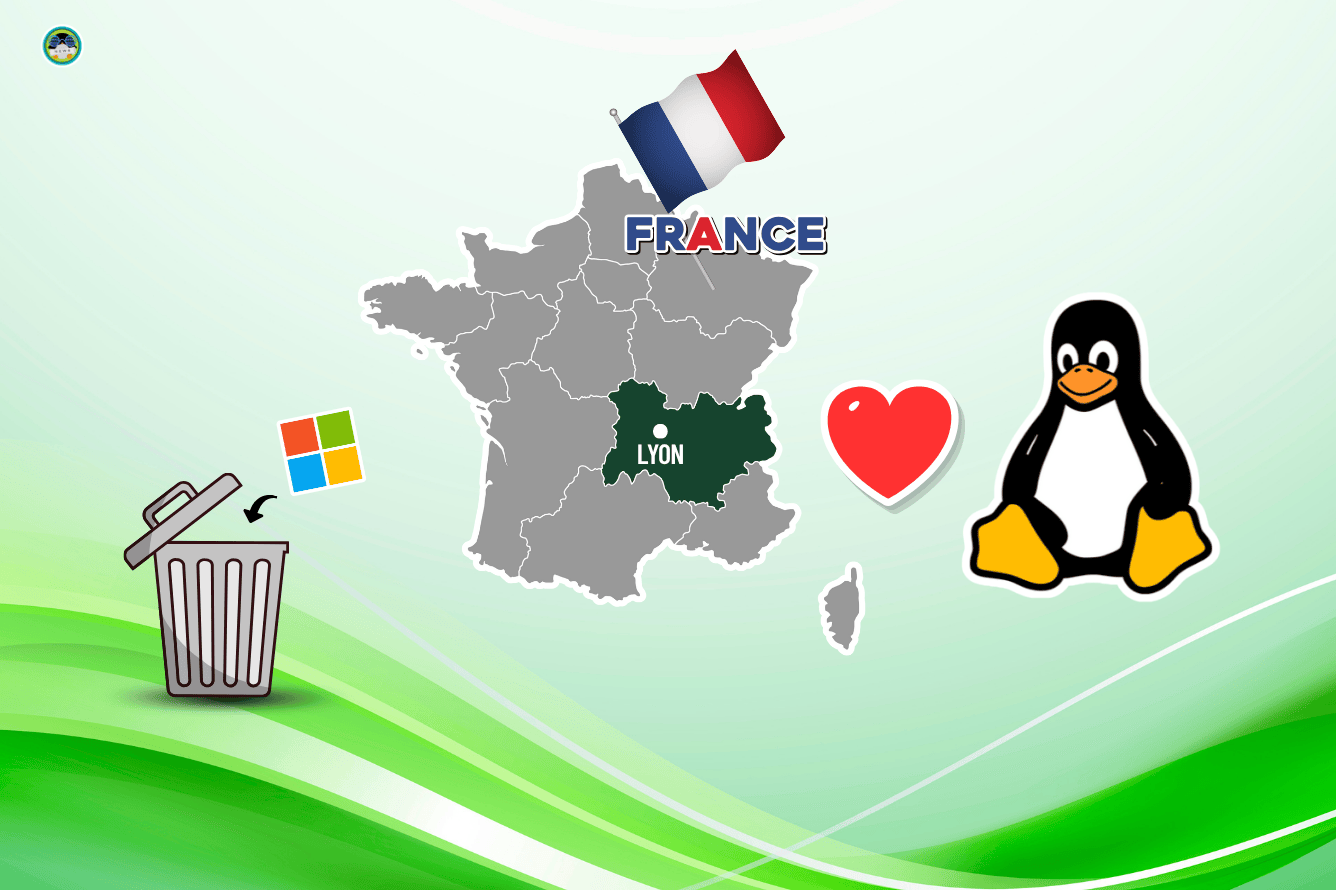
Driven by concerns over data privacy and digital sovereignty, the French city of Lyon is leading the charge, officially initiating a transition away from Microsoft software. They'll gradually replace Microsoft Office with ONLYOFFICE, Windows with Linux-based operating systems, and launch the Territoire Numérique Ouvert (TNO) open-source collaborative platform. TNO integrates tools like Jitsi, Nextcloud, Zimbra, Chamilo, and Matrix. This initiative, backed by €2 million in funding, is already being used by thousands of employees across several French local governments. Will Lyon's move inspire other European nations to follow suit?

Read more
Tech

The Hunt for the Legendary Hacktoberfest Tees

2025-07-05
The Hunt for the Legendary Hacktoberfest Tees

A developer's quest to recreate their beloved, worn-out Hacktoberfest t-shirts leads them on a frustrating search for high-resolution design assets. After years of wearing the free shirts given for participation, they're now trying to reproduce them but struggle to find suitable images online. Low-resolution images, AI upscaling failures, and missing years of designs are all part of the journey. The author pleads for help from the community to locate the missing high-resolution logos.

Read more
1 2 126 127 128 130 132 133 134 596 597