Category: Development

RubyGems.org's Multi-Layered Defense Against Malicious Gems

2025-08-26

RubyGems.org recently thwarted an attack involving malicious gems designed to steal social media credentials. Their success stems from a multi-layered security approach: automated detection (static and dynamic code analysis), risk scoring, retroactive scanning, and external intelligence. Upon detection, suspicious gems undergo manual review; confirmed malicious gems are removed and documented. In a recent incident, RubyGems.org removed most malicious packages before Socket.dev's report and actively collaborated on the investigation, demonstrating effective security response. The article encourages community participation in security maintenance and calls for corporate support of RubyGems.org's security efforts.

Development Malicious Gems
DeepWiki: Your AI Coding Powerhouse

2025-08-26
DeepWiki: Your AI Coding Powerhouse

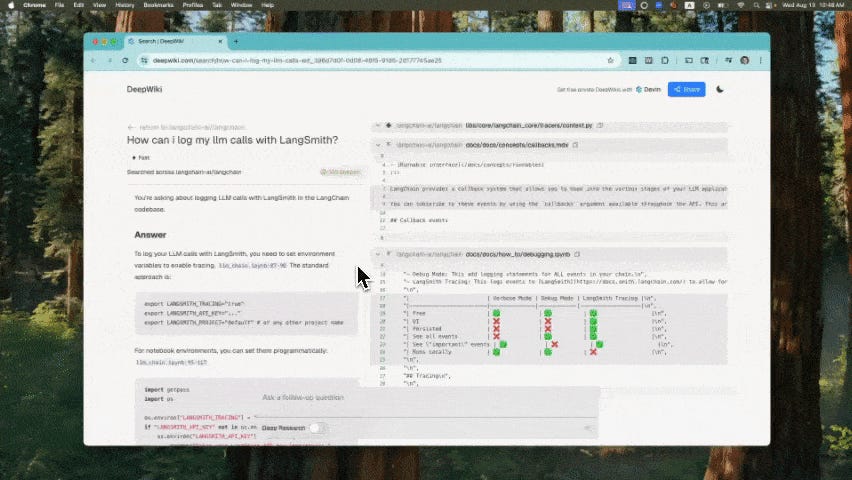
DeepWiki instantly transforms any GitHub repository into a navigable wiki, dramatically boosting AI-assisted coding efficiency. It offers fast and deep search modes, providing precise answers with source code links. The DeepWiki MCP server integrates seamlessly with AI IDEs like Claude and Cursor for real-time context querying. DeepWiki helps understand codebases, generate code snippets, evaluate open-source library security and licenses, and even assists with code reviews. Whether you're a beginner or an expert, DeepWiki is a powerful tool for efficient coding.

Development

Real-time 3D Human Motion Detection and Visualization using WiFi CSI

2025-08-26
Real-time 3D Human Motion Detection and Visualization using WiFi CSI

WiFi-3D-Fusion is an open-source project that leverages Channel State Information (CSI) from local Wi-Fi to perform real-time human motion detection and 3D visualization. Supporting both ESP32-CSI and Nexmon data acquisition, it employs advanced CNNs for person detection and tracking, including multi-person identification and re-identification. A continuous learning pipeline allows the model to automatically improve during operation. Visualization is offered through both a web interface and a terminal-based pipeline. Optional integrations with Person-in-WiFi-3D, NeRF², and 3D Wi-Fi Scanner are also provided.

Annotated Transformer: A Line-by-Line Implementation

2025-08-26

This document presents an annotated, line-by-line PyTorch implementation of the Transformer paper. It reorders and removes some sections from the original paper and adds comments throughout. The notebook provides a complete, runnable implementation, explaining the Transformer architecture (encoder, decoder, attention, positional encoding, etc.), training process, and a real-world example (Multi30k German-English translation).

Development

Scala Capture Checking: The Tech Behind a Failed Talk

2025-08-26

This article recounts the author's failed presentation on capture checking at Scala Days 2025 and the subsequent deep dive into the technology. Capture checking aims to solve the problem of values escaping their intended scope, such as premature closure of resources in try-with-resource patterns. Scala implements capture checking by introducing 'capture sets', a type system feature that allows marking a type and all values it captures. The article details capture sets, subtyping, syntactic sugar, and the mechanisms for capturing functions and classes, exploring capture set behavior in type parameters. Ultimately, the author argues that while capture checking involves many details, it's a largely invisible feature for most developers, improving Scala's safety and enabling wider capabilities usage.

Development Capture Checking

Unexpected CPU Performance Boost from Data Structure Optimization

2025-08-26

A program processing a large dataset encountered memory and CPU performance bottlenecks. Initially using a single array to store data resulted in up to 1GB of memory consumption. By employing data-oriented programming, splitting the data into multiple arrays saved approximately 200MB of memory. Further optimization involved replacing a string array with byte array indices for field names, further reducing memory usage. Surprisingly, this change also significantly decreased CPU usage. The reason lies in the garbage collection mechanism: processing a string array requires the GC to traverse all string objects, while processing a byte array doesn't, thus drastically reducing GC overhead.

xv6-riscv-net: Bringing TCP/IP Networking to RISC-V xv6

2025-08-26
xv6-riscv-net: Bringing TCP/IP Networking to RISC-V xv6

This project integrates a TCP/IP stack into the RISC-V version of the xv6 operating system, enabling network functionality. It includes a kernel-space port of the microps user-space TCP/IP stack, a virtio-net driver for network emulation in QEMU, a standard socket API, and a simple ifconfig command. A few commands build and launch QEMU, configure IP addresses, and allow pinging the xv6 guest from the host, along with testing TCP/UDP echo applications.

Development

Pushing the Limits of Time Synchronization on Linux: A 500ns Accuracy Challenge

2025-08-26
Pushing the Limits of Time Synchronization on Linux: A 500ns Accuracy Challenge

This post details an author's month-long quest to achieve high-precision time synchronization across multiple Linux systems on a local network. The goal was sub-microsecond accuracy for distributed tracing. Despite using GPS and Chrony, the author found achieving ideal precision challenging. GPS receiver jitter, network latency, and asymmetry introduced hundreds of nanoseconds of error. Ultimately, around 500ns synchronization accuracy was achieved on most systems—not quite the target, but sufficient for distributed tracing.

Development

macOS CLI Tools: Stop Using ~/Library/Application Support!

2025-08-26
macOS CLI Tools:  Stop Using ~/Library/Application Support!

Many macOS command-line tools incorrectly store configuration files in ~/Library/Application Support, contradicting user expectations and the XDG standard. The article argues that popular libraries and dotfile managers adhere to the XDG standard, placing config files in ~/.config. The author contends that CLI tools should follow this convention for improved user experience and consistency; only GUI applications should utilize ~/Library/Application Support.

Understanding Big O Notation: A Practical Guide

2025-08-25
Understanding Big O Notation: A Practical Guide

This article provides a clear and concise explanation of Big O notation, a method for describing algorithm performance. Using JavaScript's `sum` function as an example, it compares the differences between O(1) constant time, O(log n) logarithmic time, O(n) linear time, and O(n^2) quadratic time complexities. Visualizations and code examples illustrate the time complexities of various algorithms, including bubble sort and binary search. The article also explores techniques for improving code performance, such as avoiding `indexOf` within loops and leveraging caching to reduce redundant computations. Finally, it emphasizes the importance of empirical testing, cautioning against blindly trusting theoretical results.

Development time complexity

Taming the Synchronized Demand Spike: A Principled Approach

2025-08-25
Taming the Synchronized Demand Spike: A Principled Approach

Synchronized demand, where a large number of clients request service almost simultaneously, can overwhelm even well-resourced systems. This article presents a principled approach to mitigate this using randomized jitter to spread requests over time. By calculating a safe window size (W), requests are uniformly distributed, thus reducing peak arrival rate. The article further discusses leveraging server-side hints (like Retry-After headers) and rate limiting to refine the strategy, balancing system stability and fairness. The approach is framed as a control problem, emphasizing the need for telemetry-driven decision-making and verification.

Development

PEP: A New Ultra-Efficient Compression Format for Pixel Art

2025-08-25
PEP: A New Ultra-Efficient Compression Format for Pixel Art

PEP is a novel image compression format specifically designed for low-color pixel art (≤16 colors is optimal, up to 256 colors are supported). It uses "Prediction by Partial Matching, Order-2" compression, which is 2-10x slower than GIF, PNG, and QOI, but often compresses images 20-50% smaller than GIF/PNG (and multiple times smaller than QOI). If compressed image size matters, PEP is for you. It sits somewhere between GIF and WEBP in terms of speed/compression tradeoff. This is currently experimental, but a C header is provided for use.

Development

decode-kit: A Lightweight TypeScript Runtime Data Validation Library

2025-08-25
decode-kit: A Lightweight TypeScript Runtime Data Validation Library

decode-kit is a lightweight, zero-dependency TypeScript library for validating arbitrary runtime data. It uses assertion-based validation that refines your types in-place—no cloning, no transformations, and minimal runtime overhead. decode-kit validates your data and narrows its type directly; your original values remain unchanged. It employs a fail-fast approach, throwing a detailed error on the first validation failure, including the location and expected schema. Supporting various data types (strings, numbers, booleans, arrays, objects) with configurable rules, decode-kit outperforms libraries like Zod due to its in-place type assertion, making it ideal for performance-critical applications.

Development

Firefox Extension: One-Click Highlighted Elements for Enhanced Keyboard Navigation

2025-08-25

A developer, h43z, created a small Firefox extension to address the shortcomings of keyboard navigation in modern websites. The extension allows users to click highlighted elements with the Enter key after using the browser's find feature, significantly improving efficiency, especially on sites using buttons and divs instead of links for navigation. It achieves this by listening for keyboard events, getting the parent element of the selected text, and simulating a click.

Development keyboard navigation

OAuth 2.0: Securely Authorizing Third-Party App Access to Your Data

2025-08-25
OAuth 2.0: Securely Authorizing Third-Party App Access to Your Data

OAuth 2.0 is an authorization protocol allowing users to grant third-party apps access to their account data without sharing passwords. This article details the OAuth 2.0 workflow, including user authorization, authorization code retrieval, access token exchange, and emphasizes security measures like avoiding direct access token transmission in URLs. Key OAuth 2.0 terminology is explained, such as resource owner, OAuth client, authorization server, and resource server, along with front-channel and back-channel concepts. The article also covers PKCE for backend-less applications.

Development

4.4KB Ultra-Lightweight AI Agent Executes Shell Commands via OpenRouter API

2025-08-25
4.4KB Ultra-Lightweight AI Agent Executes Shell Commands via OpenRouter API

An ultra-lightweight AI agent written in C that communicates with the OpenRouter API and executes shell commands. Key features include: direct shell command execution via AI responses; optimized binaries (4.4KB on macOS, ~16KB on Linux); sliding window memory management for efficiency; cross-platform support for macOS and Linux. Requires GCC, curl, and an OpenRouter API key. The build system auto-detects your platform and applies optimal compression (GZEXE for macOS, UPX for Linux). The code is public domain, with no license.

Development shell commands

Provider-Agnostic CAS Cache with Pluggable Codecs and Generation Store

2025-08-25
Provider-Agnostic CAS Cache with Pluggable Codecs and Generation Store

cascache is a provider-agnostic Compare-And-Set (CAS) cache featuring pluggable codecs and a generation store. It offers safe single-key reads (no stale values), optional bulk caching with read-side validation, and an opt-in distributed mode for multi-replica deployments. Cascache ensures CAS safety using generation snapshots, supports various underlying stores (Ristretto, BigCache, Redis) and codecs (JSON, Msgpack, CBOR, Proto), and provides both local and distributed generation storage modes for high performance and availability.

Development

SmallJS: An Elegant Smalltalk-80 Compiler for JavaScript

2025-08-25

SmallJS is a free and open-source implementation of the elegant Smalltalk-80 language, compiling to JavaScript that runs in modern browsers or Node.js. Its file-based architecture allows development in your favorite IDE, with default support for Visual Studio Code, including syntax highlighting and debugging. Fully object-oriented and highly customizable, SmallJS maintains familiar JS counterparts for class and method names. It boasts built-in libraries for both browser (DOM manipulation, events, CSS) and Node.js (HTTP server, Express, databases, file system, multi-threading) environments. Several example projects are provided to get you started quickly.

Development

The Art of API Design: Balancing Simplicity and Flexibility

2025-08-25

This article delves into the crucial principles of API design, emphasizing the importance of avoiding breaking changes to existing user code. The author argues that good APIs should be simple and easy to use, yet maintain long-term flexibility. The article details technical aspects such as API versioning, idempotency, rate limiting, and pagination, and recommends using API keys for authentication to make it easier for non-engineer users. It concludes that a great product outweighs a perfect API, but a poorly designed product will inevitably lead to a poor API.

Development

Python 2025: Data Science Dominates, Async & Rust Rise

2025-08-25
Python 2025: Data Science Dominates, Async & Rust Rise

The 2025 Python Developers Survey reveals data science now comprises over half of Python development, with Pandas and NumPy leading the way. Despite many using older Python versions, significant performance gains (up to 42%) are available in newer releases. Web development shows resurgence, with FastAPI framework surging in popularity. Rust is increasingly integrated for performance boosts. Async programming and multithreading are gaining traction, with Python 3.14 fully supporting GIL-free threading. Documentation is the top learning resource, and AI tools are rapidly gaining adoption.

Development

The Clever Design and Shortcomings of C++'s std::adjacent_difference

2025-08-25

This article delves into the design philosophy of the `std::adjacent_difference` algorithm in the C++ standard library. This algorithm computes the differences between adjacent elements of an input sequence, copying the first element to the output. While this design ensures symmetry with `std::partial_sum`, mirroring differentiation and integration in calculus, it also limits its genericity, as the difference between elements of an arbitrary type might have a different type. The article further draws parallels to derivatives and integrals in calculus, explaining the algorithm's design rationale and contrasting it with Q's more flexible `deltas` function. The conclusion is that, while Stepanov's original intent was sound, the algorithm lacks genericity; C++23's `pairwise_transform` offers a more flexible alternative.

Development generic programming

Algorithm Nightmare: An O(EV+VlogVlogK) Solution for Counting Paths of Length K

2025-08-25

This article tackles a seemingly simple algorithmic problem: finding the number of paths of length K between nodes A and B in a directed, unweighted graph. Starting with basic BFS and dynamic programming, the author delves into more advanced techniques, including matrix exponentiation, linear recurrences, generating functions, annihilating polynomials, and the Berlekamp-Massey algorithm. The result is a stunning O(EV+VlogVlogK) solution, significantly faster than traditional O(EK) or O(V³logK) approaches. The author clearly explains the principles and connections between these algorithms, highlighting the problem's complexity and the elegance of the solution.

Development linear recurrences

Parquet v2: Performance Gains vs. Ecosystem Adoption Hurdles

2025-08-25

Parquet version 2 offers significant performance improvements, reducing file sizes and speeding up read/write times, especially for datasets with many numeric values. However, limited ecosystem support means many tools remain incompatible, hindering the realization of these gains. The author encountered compatibility issues firsthand, highlighting that v2's advantages primarily benefit self-contained systems, while third-party integration remains challenging. While Parquet v2 shows performance improvements, its low adoption currently limits its practical benefits. Consider adopting the latest specification only if you control the entire data processing pipeline.

Development

Rust In-Memory Filesystem Performance: Surprisingly, It Doesn't Matter

2025-08-25

While building a CLI tool in Rust, the author attempted to use an in-memory filesystem for faster file management tests. After exploring crates like `vfs` and `rsfs`, the surprising conclusion was that modern SSDs and OS filesystem caching are so efficient that there's virtually no performance gain from using an in-memory filesystem. Benchmarks consistently showed around 45ms for tests using in-memory filesystems, regular filesystems, and even a ramdisk—a stark contrast to expectations. The author invites readers to share examples where using an in-memory filesystem yields noticeable performance differences.

Development in-memory filesystem

Sping: A Modern Terminal HTTP/TCP Latency Monitor

2025-08-25

Sping is a modern terminal-based tool for monitoring HTTP/TCP latency with real-time visualization, phase timing, and advanced analytics. It supports HTTP and TCP protocols, displaying response times, outlier detection, and statistics in an interactive terminal UI or via plain text and JSON output. Features include customizable intervals, counts, thresholds, and multiple color palettes. Easy to install via pip and produces compelling screenshots for collaboration, sping helps diagnose network latency issues at layers 4+.

ContextForge MCP Gateway: Unifying REST, MCP, and A2A

2025-08-25
ContextForge MCP Gateway: Unifying REST, MCP, and A2A

ContextForge MCP Gateway is a powerful gateway, proxy, and MCP registry that federates MCP and REST services, unifying discovery, auth, rate-limiting, observability, virtual servers, multi-transport protocols, and an optional admin UI into a single, clean endpoint for your AI clients. It runs as a fully compliant MCP server, deployable via PyPI or Docker, and scales to multi-cluster environments on Kubernetes with Redis-backed federation and caching. Currently in alpha/early beta, it's not production-ready but ideal for development and experimentation. Note: This is an open-source component with no official support from IBM.

Development Gateway

Git Annex: Master Your Data, No Matter Where It Is

2025-08-25

Bob and Alice face data management challenges: Bob needs to archive data across multiple offline drives, while Alice needs a seamless solution for managing data across a netbook, USB drives, and a cloud server. Git Annex solves both problems. For Bob, it provides a single directory tree for all files, regardless of their physical location, simplifying organization and preventing accidental data loss. For Alice, it manages various data sources like git remotes, enabling easy synchronization and version control without manual intervention. Whether offline or on the move, Git Annex ensures data accessibility, security, and long-term preservation.

Development

Calculating Credit Card Debt with Code: Is Math Essential for Programmers?

2025-08-24
Calculating Credit Card Debt with Code: Is Math Essential for Programmers?

This article explores whether math is essential background knowledge for programmers. By building an Elixir program simulating credit card repayment, the author demonstrates how simple formulas and programming can solve real-world problems, such as calculating compound interest and repayment schedules. The program's simulation shows that slightly increasing the minimum payment percentage or adding a small extra monthly payment significantly reduces repayment time and saves substantial money, highlighting the importance of understanding compound interest and financial planning. Even without advanced math, practical application is shown.

Development

SQLite's WAL Mode: Durability vs. Performance Trade-off

2025-08-24

SQLite's WAL (Write-Ahead Log) mode, often used for higher write throughput, compromises data durability compared to the default journal mode. The `synchronous` pragma controls how often fsync is called; the default is NORMAL. In NORMAL mode, WAL files are synced before each checkpoint, and the database file after, but most transactions lack sync operations. For applications where durability isn't critical, NORMAL is sufficient. For guaranteed durability across power loss, `synchronous=FULL` adds a WAL file sync after each transaction commit, increasing durability at the cost of write speed. This explanation, prompted by concerns about SurrealDB potentially sacrificing durability for benchmark performance, clarifies SQLite's approach.

(avi.im)

The Wicked Trick: Dynamically Patching Python Function Source Code at Runtime

2025-08-24

This post details a fascinating yet dangerous technique: dynamically altering a Python function's source code at runtime. By manipulating the `.__code__` attribute, recompiling, and injecting into a namespace, the author demonstrates dynamic function replacement. This powers LlamaBot's ToolBot, which focuses on tool selection, not execution. Generated code compiles and runs in the same Python environment, accessing runtime variables for enhanced AI capabilities. While security risks exist, this showcases Python's flexibility and the importance of separating tool selection from execution in LLM agents.

Development Dynamic Code
1 2 17 18 19 21 23 24 25 214 215