Category: Development

Shallow Understanding of Tech: Good Enough is Good Enough

2025-05-27

The author argues that a shallow understanding of the technologies engineers use is sufficient. Deep dives into database indexes, large language models, etc., enable better decision-making; for example, choosing appropriate models for JSON output and avoiding errors caused by limitations in smaller models. Instead of going deep in one area, the author advocates for broad knowledge across many areas to better adapt to new trends. Learning new technologies should focus on understanding fundamental principles and explaining them simply to others, while using LLMs for fact-checking to ensure accuracy.

Development

Xata's Efficient MCP Server: OpenAPI, Kubb, and a Pinch of Next.js

2025-05-27
Xata's Efficient MCP Server: OpenAPI, Kubb, and a Pinch of Next.js

Xata built an MCP server enabling secure real-time interaction between AI models and tools/APIs. Instead of hand-coding each tool, they leveraged their existing OpenAPI specification and Kubb, a code generation tool, to automate the process. This approach uses the OpenAPI spec as a single source of truth, ensuring rapid development and consistency. The post details migrating to Kubb, creating custom generators, and building the MCP server with Next.js, resulting in an efficient AI integration.

Development

Pyrefly and ty: Two New Rust-Based Python Type Checkers Emerge

2025-05-27

At PyCon 2025, Meta's Pyrefly and Astral's ty, two new Rust-based Python type checkers, made their debut. Pyrefly aims to be faster, more portable, and more capable than its predecessor, while actively engaging with the open-source community. ty emphasizes a "gradual guarantee," meaning removing type annotations shouldn't cause type errors. Both leverage Ruff for AST parsing and offer command-line and IDE integration. Benchmarks showed ty generally faster, but they differ in type inference and error handling. Pyrefly is more aggressive, potentially catching more errors but also introducing more false positives; ty is more conservative, prioritizing code compatibility. Both are in early alpha, and their future evolution is exciting to watch.

Development Type Checker

arXivLabs: Experimental Projects with Community Collaborators

2025-05-27
arXivLabs: Experimental Projects with Community Collaborators

arXivLabs is a framework that enables collaborators to develop and share new arXiv features directly on the arXiv website. Individuals and organizations working with arXivLabs embrace and adhere to our values of openness, community, excellence, and user data privacy. arXiv is committed to these values and only works with partners who share them. Have an idea for a project that will benefit the arXiv community? Learn more about arXivLabs.

Development

Malai 0.2.5 Released: Easily Share Your Local TCP Services

2025-05-27

Malai 0.2.5 introduces the ability to share your local TCP services, allowing you to securely expose any locally running TCP service (e.g., SSH, Postgres, Redis, etc.) to the outside world. Simply use a simple command to share a port and connect from other machines using the `malai tcp-bridge` command. Additionally, Malai now includes a `malai folder` command for sharing local folders. This update provides a more convenient and secure way for developers and teams to collaborate, such as for remote debugging, sharing databases, or game servers.

Development Network Sharing

From Arc to Dia: The Browser Company's AI Pivot

2025-05-27
From Arc to Dia: The Browser Company's AI Pivot

The Browser Company announces its pivot from its browser project, Arc, to a new AI-powered browser, Dia. The article explains that despite Arc's loyal user base, it fell short of expectations due to growth limitations, hesitation in embracing AI, and communication issues. The author admits Dia isn't a simple iteration of Arc but rather a response to the future of browsers—AI will fundamentally reshape how we interact with computers, and traditional browsers will be replaced by AI browsers. Dia aims to address Arc's shortcomings, offering a simpler, faster, and more secure experience. The article also touches on Arc's future, stating it won't be open-sourced immediately but will continue to be maintained.

Development Pivot

Quiet Homelab: OpenShift Cluster on Refurbished ThinkCentre Tinys

2025-05-27
Quiet Homelab: OpenShift Cluster on Refurbished ThinkCentre Tinys

This post details a low-power, quiet homelab built using refurbished Lenovo ThinkCentre Tiny PCs. Running Red Hat Enterprise Linux, these compact machines are used to host an OpenShift cluster, though they're versatile enough for Kubernetes or other containerized applications. The author details the hardware, costs (around €416 total), and even provides a 3D-printed rack-mounting solution. A perfect example of how to build a powerful yet unobtrusive home server setup.

Development

Cline: Ditching RAG for a New Paradigm in AI Code Assistance

2025-05-27
Cline: Ditching RAG for a New Paradigm in AI Code Assistance

Cline, an AI code assistant, eschews the popular RAG (Retrieval Augmented Generation) approach in favor of a method more aligned with developer thinking. The article highlights three major problems with RAG for code: fragmented code logic, index-code desynchronization, and security risks. Cline addresses these by understanding code structure (ASTs), exploring code logic file by file, and building context to provide more accurate and secure code suggestions. It leverages powerful modern language models, reading and understanding code directly on the local machine without vector databases or embeddings, avoiding the pitfalls of RAG and offering superior code suggestions.

Development code understanding

DuckLake: Lightweight Data Lake and Catalog in One

2025-05-27
DuckLake: Lightweight Data Lake and Catalog in One

DuckLake offers a lightweight, all-in-one solution for building a data lake and catalog. It enables a 'multiplayer DuckDB' setup with multiple DuckDB instances reading and writing the same dataset—a concurrency model not supported by standard DuckDB. Even if you only use DuckDB for your DuckLake entry point and catalog database, you still benefit from features like time-travel queries, data partitioning, and storing data across multiple files instead of a single, potentially huge, database file.

Development data lake

AWS Aurora DSQL: A Database Architecture Revolution from JVM to Rust

2025-05-27
AWS Aurora DSQL: A Database Architecture Revolution from JVM to Rust

AWS announced Aurora DSQL at re:Invent, and this post delves into its development journey. To tackle the challenge of horizontally scaling writes in traditional databases, the AWS team initially used JVM but encountered severe performance bottlenecks, especially tail latency issues caused by garbage collection. They ultimately decided to rewrite the data plane in Rust, which significantly improved performance and reduced tail latency. Furthermore, the team also migrated the control plane to Rust, avoiding the complexities of multiple languages. This project demonstrates that questioning existing solutions and experimenting with new technologies (even costly language migrations) can yield significant rewards.

Development

LiveStore Event Definitions: A Concise Todo List Management System

2025-05-27
LiveStore Event Definitions: A Concise Todo List Management System

This code snippet defines events for managing a todo list within the LiveStore framework. It includes four events: creating a todo item (todoCreated), marking it as complete (todoCompleted), marking it as incomplete (todoUncompleted), and deleting a todo item (todoDeleted). Each event uses Schema.Struct to define its data structure, ensuring data consistency and integrity. This showcases a concise and efficient todo list management system design, leveraging an event-driven architecture to track changes in todo item status.

AI-Assisted Development: The Architect's Ascent

2025-05-27
AI-Assisted Development: The Architect's Ascent

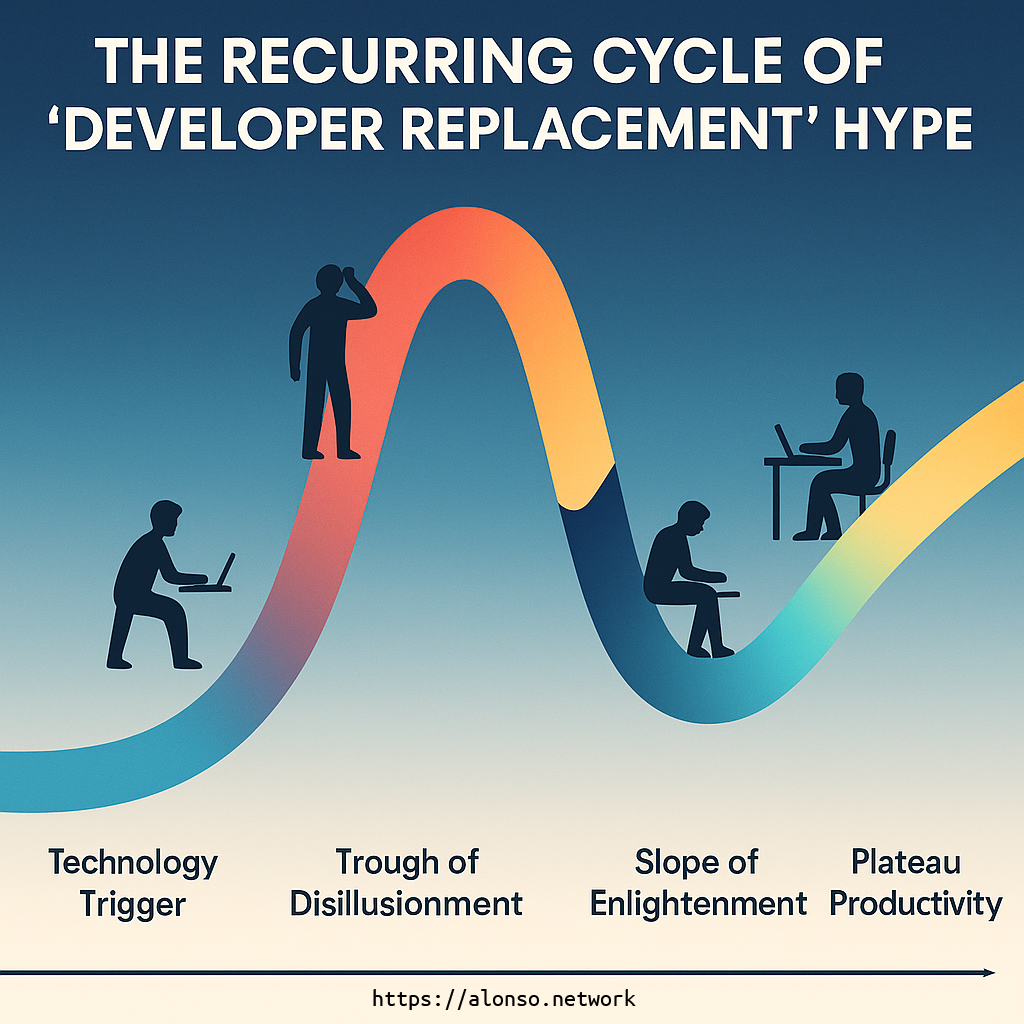
From NoCode to AI-assisted development, technological advancements haven't rendered developers obsolete; instead, they've reshaped roles and skill requirements. Past waves of NoCode, cloud computing, and offshore development didn't eliminate developers but created new specializations like NoCode specialists and DevOps engineers, often with higher salaries. AI-assisted development follows this pattern. AI excels at code generation, but it struggles with system architecture. Thus, the most valuable skill in software engineering will be system architecture—a domain where AI lags significantly. AI accelerates development, increasing the complexity of system maintenance and highlighting the crucial role of experienced architects in managing and mitigating risks.

Development

LumoSQL: Enhancing SQLite with Security and Performance

2025-05-27

LumoSQL is a modification, not a fork, of the widely used SQLite database. It enhances SQLite by adding security, privacy, performance, and measurement features, and boasts pluggable backend key-value store engines like LMDB. Utilizing a novel 'not-forking' tool, LumoSQL manages multiple upstream codebases without forking, collaborating with the SQLite project to introduce improvements without compromising SQLite's core stability. LumoSQL demonstrates enhancements that many users need but aren't readily available in the core SQLite project due to its cautious approach.

Development

Mesa 25.1.1 Windows Builds Released: Troubleshooting Common Issues

2025-05-27
Mesa 25.1.1 Windows Builds Released: Troubleshooting Common Issues

Mesa 25.1.1 builds for Windows (using Visual Studio and MSYS2 Mingw-w64) are now available. This release was sponsored by Petrosky, providing a dedicated build machine. The release addresses numerous common issues, such as missing libgallium_wgl.dll, libEGL.dll, and libvulkan-1.dll errors, often fixable by redeploying applications or using provided fix tools. Comprehensive documentation details differences between MSVC and MinGW packages, package contents, configuration and usage of various drivers (llvmpipe, GLonD3D12, zink, etc.), legacy software compatibility, OpenGL context configuration overrides, and provides solutions and environment variable settings.

Development

Clojure MCP: REPL-Driven Development with AI Assistance

2025-05-27
Clojure MCP: REPL-Driven Development with AI Assistance

Clojure MCP is an alpha-stage project offering a comprehensive suite of tools to aid Clojure development by connecting AI models to the Clojure nREPL. It includes all the features of Claude Code, integrates tools like clj-kondo and parinfer, and seamlessly integrates with Claude Desktop. Developers can leverage AI for incremental development, validating code in the REPL, and utilizing tools like smart file reading, structure-aware editing, and code evaluation for enhanced efficiency. The project also features a workflow for maintaining an LLM-friendly project summary, enabling the AI assistant to quickly grasp the codebase. The project is licensed under the GNU Affero General Public License v3.0.

Development

arXivLabs: Building New arXiv Features with Community Collaboration

2025-05-27
arXivLabs: Building New arXiv Features with Community Collaboration

arXivLabs is a framework enabling developers to collaborate and share new arXiv features directly on the arXiv website. Participants must embrace arXiv's values of openness, community, excellence, and user data privacy. Got an idea to enhance the arXiv community? Learn more about arXivLabs and get involved!

Development

yes-rs: A Blazingly Fast, Memory-Safe Rust Rewrite of Unix 'yes'

2025-05-27
yes-rs: A Blazingly Fast, Memory-Safe Rust Rewrite of Unix 'yes'

Tired of the memory-unsafe and overflow-prone C version of the Unix 'yes' command? Meet yes-rs, a Rust rewrite that's not only blazingly fast but also guarantees memory safety with zero unsafe code blocks. Clocking in at a hefty 1302 lines of Rust (compared to the original C's ~50), yes-rs boasts modern error handling, zero-cost abstractions, and the ability to output custom strings. Built with Cargo, it's easy to install and use. For those demanding ultimate performance and safety, yes-rs is the answer!

Development

Stalwart v0.12: A Unified Communication & Collaboration Platform

2025-05-27
Stalwart v0.12: A Unified Communication & Collaboration Platform

Stalwart v0.12 is here, transforming from a powerful mail server into a complete communication and collaboration platform. This release introduces native support for calendars, contacts, and file storage, eliminating the need for third-party integrations. Users can manage events, address books, and documents through any standards-compliant client. Improved spam filtering, enhanced performance optimizations for large deployments, and flexible cluster coordination round out the key features. Future releases will add CalDAV scheduling, event notifications, and JMAP support for an even smoother experience.

Sqawk: SQL-powered command-line tool for processing delimited files

2025-05-26
Sqawk: SQL-powered command-line tool for processing delimited files

Sqawk is an SQL-based command-line tool inspired by awk, designed for efficient processing of delimiter-separated files like CSV and TSV. It loads data into in-memory tables, allowing for powerful SQL queries (SELECT, INSERT, UPDATE, DELETE) with filtering, sorting, aggregation, and multi-table joins. Sqawk boasts features like automatic type inference, null value support, custom delimiters, and a safe operation mode preventing accidental file modification. Its intuitive syntax and speed make it ideal for data manipulation tasks.

Development

Dav1d Performance Boost: Cacheline Alignment Optimizations

2025-05-26
Dav1d Performance Boost: Cacheline Alignment Optimizations

A developer significantly improved the performance of the Dav1d video decoder by optimizing the memory alignment of its structures. By rearranging structure members and using more compact data types, memory fragmentation was reduced, achieving optimal 8-byte alignment on 64-bit processors. Benchmark results showed a roughly 0.5% and 2.8% reduction in decoding time for 1080p and 4K videos, respectively. This optimization highlights the importance of meticulous memory management for performance gains and offers valuable insights for optimizing other C/C++ projects.

CSMWrap: Bringing Legacy BIOS to UEFI Systems

2025-05-26
CSMWrap: Bringing Legacy BIOS to UEFI Systems

CSMWrap is a clever hack that emulates a legacy PC BIOS on UEFI-only systems. Leveraging SeaBIOS's CSM (Compatibility Support Module) and VESA VBIOS, it allows booting FreeDOS, Windows XP, and Windows 7 in QEMU and some real hardware. It achieves this by unlocking the legacy BIOS memory region, loading the SeaBIOS CSM module, configuring memory mapping, and more. Note that Secure Boot and Above 4G Decoding must be disabled, and there may be Windows video modesetting issues.

Development

The Elegant Struggle: Designing Public/Private Members in a Scripting Language

2025-05-26

A developer, building a fantasy console project, grapples with adding a module system to their scripting language. Exploring various approaches to distinguish public and private declarations – modifier keywords (like Java's `public` and `private`), modifier sections (like C++), sigils in identifiers (like Python's underscore), export manifests (like Scheme), and sigils at declarations (like Oberon's `*`) – they lean towards a novel solution: prefixing declaration keywords with an underscore (e.g., `rec_` for private records, `def_` for private functions). While unconventional, this method offers conciseness and avoids repeating sigils at every use site.

Development module system

CSS Paint Worklet: Level Up Your Background Images

2025-05-26
CSS Paint Worklet: Level Up Your Background Images

This example demonstrates creating dynamic background images using CSS Paint Worklet. By defining custom properties `--boxColor` and `--widthSubtractor`, and using the CSS `nth-of-type` selector, we generate background images with varying colors and widths for list items. The JavaScript registers an external paint worklet script, `boxbg.js`, which contains the logic for drawing the background. The final result is customizable; tweak the custom property values in DevTools to alter the colors and widths.

Development Custom Background

Lazy Trees Land in Determinate Nix 3.5.2: A Massive Performance Boost for Nix

2025-05-26
Lazy Trees Land in Determinate Nix 3.5.2: A Massive Performance Boost for Nix

Determinate Nix 3.5.2 has landed, bringing with it the highly anticipated lazy trees feature. This significantly improves Nix's efficiency in large repositories, especially massive monorepos, by using a virtual filesystem to optimize file copying. Tests show evaluations in Nixpkgs can be 3x faster and use 20x less disk space. Users can opt-in by enabling `lazy-trees = true` in their custom Nix configuration. While currently opt-in, the team has submitted a pull request to merge this into upstream Nix. Future performance improvements are planned, including better evaluation caching, parallel evaluation for more Nix operations, and multi-threaded unpacking of flakes.

Development Lazy Trees

The AI Cheating Plague: A Professor's Frontline Report

2025-05-26
The AI Cheating Plague: A Professor's Frontline Report

A university professor recounts the widespread phenomenon of students using AI to cheat, detailing the challenges and strategies he's encountered in his teaching. From initially allowing students to cite AI tools to discovering pervasive cheating, he's experimented with various methods to deter AI use, including employing Google Docs in class and requiring handwritten assignments. The article explores AI's impact on education and how to cultivate critical thinking and learning skills in students, advocating a renewed focus on the learning process rather than solely on outputs.

Development teaching

Beyond Zig and Rust: A More Human-Friendly Approach to Metaprogramming

2025-05-26

This article explores a novel programming language design that combines the strengths of Rust's Hindley-Milner type system and Zig's compile-time capabilities, while avoiding the complexities of Zig's 'types as values' approach. By introducing the `@` operator for compile-time execution, the `Abstract` type for compile-time abstractions, `TypeInfo` and `Field` types for type introspection, and `Code` and `parse` functions for code manipulation, this design achieves powerful metaprogramming capabilities such as automatic code generation and the implementation of TypeScript-like utility types like `Partial`, all while maintaining code readability and ease of reasoning. This represents a new approach to achieving powerful metaprogramming while preserving type system friendliness, offering fresh perspectives for future language design.

Development

Mutmut: A Powerful Mutation Testing Tool for Python

2025-05-26
Mutmut: A Powerful Mutation Testing Tool for Python

Mutmut is a user-friendly mutation testing system for Python. It helps developers identify gaps in their test suites, leading to higher code quality. Key features include incremental testing, parallel execution, and an interactive terminal UI. Users can easily run tests, browse mutants, apply mutants, and configure various settings such as paths to mutate, test directories, and files to exclude. Mutmut also offers optimizations for large codebases and extensive configuration options for diverse needs.

Development Mutation Testing

FizzBuzz in Monads: A Functional Approach

2025-05-26

This article presents a functional programming approach to the FizzBuzz problem using Monads. The core idea leverages the guard-sequence pattern to check divisibility by 3, 5, and 7, generating 'fizz', 'buzz', and 'zork' respectively, or Nothing if not divisible. `mconcat` combines the results, and `fromMaybe` handles Nothing values, yielding the correct FizzBuzz output. This elegant solution showcases the power of functional programming.

Development

Optimal Debian Packaging Workflow for 2025

2025-05-26
Optimal Debian Packaging Workflow for 2025

This post outlines the optimal workflow for creating new Debian packages in 2025 while preserving upstream Git history. The goal is to simplify sharing improvements between upstream and Debian, and enhance software provenance and supply-chain security by easily inspecting every change using standard Git tools. Key elements include: using a Git fork/clone of the upstream repository; consistent use of `git-buildpackage` commands with package options in `gbp.conf`; DEP-14 tagging and branching; pristine-tar and upstream signatures; using `Files-Excluded` in `debian/copyright`; patch queues for rebasing and cherry-picking; leveraging Salsa (Debian's GitLab) for CI/CD and peer review. The process is demonstrated by packaging the `entr` command-line tool, walking through each step from repository creation to Merge Request submission on Salsa.

Development

A Concise Scheme Interpreter in BQN: A Minimalist Approach

2025-05-26

This article details an attempt to implement a Scheme interpreter using the BQN programming language. Leveraging BQN's concise syntax and powerful array operations, the author achieves a functional Scheme subset interpreter, including basic arithmetic, list manipulation, and metaprogramming capabilities. While not fully R5RS compliant and lacking robust error handling, the implementation's brevity and functionality are impressive. This showcases BQN's application and highlights the elegance of functional programming.

Development
1 2 75 76 77 79 81 82 83 214 215