AMD Unveils RDNA 4 Architecture and Radeon RX 9070 Series GPUs

2025-03-01

AMD Unveils RDNA 4 Architecture and Radeon RX 9070 Series GPUs

AMD officially revealed its RDNA 4 GPU architecture and the Radeon RX 9070 series, built upon it. RDNA 4 boasts significant improvements in efficiency, ray tracing, and AI performance. Featuring a single-chip design, it includes enhanced Infinity Cache and higher memory bandwidth. Targeting the mid-range market, the RX 9070 series offers performance comparable to the RTX 4070 Ti or RTX 5070 Ti, bundled with technologies like FSR 4 and HYPR-RX. AMD also introduced new software features, including an AI Apps Manager and the LLM-powered chatbot, AMD Chat, enhancing user experience.

Read more
Hardware

Apple Launches Apple Invites: A New App for Seamless Event Planning

2025-02-04
Apple Launches Apple Invites: A New App for Seamless Event Planning

Apple unveiled Apple Invites, a new iPhone app designed to simplify event planning. Users can create custom invitations, share them easily, manage RSVPs, and even contribute to shared albums and collaborative Apple Music playlists. The app integrates with Maps and Weather for convenient guest information. Apple Intelligence features (available on select iPhone models) allow users to create unique invitations using AI-powered image generation and writing tools. Anyone can RSVP, regardless of Apple account ownership, while iCloud+ subscribers gain access to expanded storage and other premium features.

Read more

arXivLabs: Community Collaboration on arXiv Features

2025-05-28
arXivLabs: Community Collaboration on arXiv Features

arXivLabs is a platform enabling developers and researchers to build and share new arXiv features directly on the arXiv website. Participants, individuals and organizations alike, embrace arXiv's values of openness, community, excellence, and user data privacy. arXiv is committed to these values and only partners with those who share them. Got an idea to enhance the arXiv community? Explore arXivLabs!

Read more
Development

Browser Extension: Redirect URLs with Regex

2025-06-01
Browser Extension: Redirect URLs with Regex

This browser extension (Firefox, Chrome, etc.) lets you redirect URLs based on custom regex or wildcard patterns. It's powerful for ad blocking, forcing desktop sites, streamlining DuckDuckGo searches, and more. Examples include redirecting YouTube Shorts to regular YouTube, or Google searches with !bangs to DuckDuckGo. Pre-built rules are included for common use cases.

Read more
Development URL redirect

Guile-powered Emacs: A Bold Rewrite Project

2024-12-16

Emacs, renowned for its extensibility, faces performance and expressiveness limitations with its core language, Emacs Lisp (Elisp). To address this, the Guile-Emacs project aims to replace Elisp in Emacs with Guile Lisp. After years of development and dormancy, Guile-Emacs has been revived by developers Robin Templeton and Larry Valkama. The project aims to leverage Guile's compiler and performance advantages to improve Emacs' speed and extensibility while maintaining Elisp compatibility. The ultimate goal is to rewrite a significant portion of Emacs's C code in Lisp, significantly enhancing its customizability. While facing technical and political challenges, the project presents exciting possibilities for the future of Emacs.

Read more
Development

AI Code Review Agents: Helpful, But Not a Silver Bullet

2025-05-07
AI Code Review Agents: Helpful, But Not a Silver Bullet

Many AI code review agents have emerged, using LLMs to analyze code diffs and identify issues. The author experimented with Coderabbit, finding it occasionally catches errors missed by human reviewers, but also generates irrelevant or incorrect suggestions. Building a basic agent is relatively easy using the GitHub API and an OpenAI key. However, LLMs struggle to fully understand code, especially without broader codebase context, leading to inaccurate suggestions. The author concludes that creating a truly helpful agent requires addressing the LLM's understanding of code and leveraging codebase context effectively.

Read more
Development

DOGE's Risky Plan to Migrate SSA's COBOL Code Sparks Concerns

2025-03-28
DOGE's Risky Plan to Migrate SSA's COBOL Code Sparks Concerns

The core systems of the US Social Security Administration (SSA) still rely on outdated COBOL code. A group called DOGE is planning to migrate millions of lines of this code to a modern language within months, but this plan has sparked serious concerns. The migration process could result in system failures affecting millions of beneficiaries' payments. Experts warn of the extreme risk of system crashes, given the SSA's complex and fragile system, likened to a house of cards or a Jenga tower. DOGE plans to utilize AI to assist in code conversion, but testing and resolving all potential edge cases would take years, not months.

Read more
Tech

RDNA 4's Dynamic VGPR Allocation: A Ray Tracing Bottleneck Breaker

2025-04-05
RDNA 4's Dynamic VGPR Allocation: A Ray Tracing Bottleneck Breaker

AMD's RDNA 4 architecture introduces a novel dynamic VGPR (vector general-purpose register) allocation mode to address the trade-off between register count and occupancy in ray tracing. Traditional GPUs face limitations in ray tracing where fixed register allocation per thread restricts thread parallelism in stages with high register demands. RDNA 4's dynamic allocation allows threads to adjust register counts at runtime, increasing occupancy without enlarging the register file, thus reducing latency and boosting ray tracing performance. While this mode can lead to deadlocks, AMD mitigates this with a deadlock avoidance mode. This isn't a universal solution, limited to wave32 compute shaders, but significantly advances AMD's ray tracing capabilities.

Read more

The Insane __init__ Method That Almost Broke My Sanity

2025-04-19
The Insane __init__ Method That Almost Broke My Sanity

A Python service test intermittently failed due to a bizarre __init__ method. The FooBarWidget class, in its __init__, starts a new thread to execute its parent class FooWidget's __init__ and run methods. This design attempts to avoid blocking the main thread because zmq.Socket objects can't be moved between threads. However, closing a FooBarWidget instance too early might leave FooWidget's __init__ unfinished, resulting in a missing 'should_exit' attribute and an error. This humorous account details the debugging ordeal and explores the rationale behind this unconventional design.

Read more
Development

Cisco Firewall and TLS 1.3 Compatibility Issues

2025-05-22

A company encountered a problem with their Cisco firewall: due to TLS 1.3 encrypting server certificates, the firewall couldn't enforce URL or application access rules based on certificate content. To solve this, Cisco introduced TLS Server Identity Discovery, using an additional TLS 1.2 handshake to retrieve the certificate in plaintext. However, this clashed with expected Postgres database behavior. The actual issue wasn't TLS 1.3 incompatibility, but rather the firewall wasn't configured to block unknown applications; it attempted to learn the certificate for 3 seconds before giving up and allowing the connection.

Read more
Tech

The Evolution of the Calculator Keypad: From 9 Keys to the Standard 10

2025-05-11

The layout of the calculator keypad wasn't always as we know it. Early Comptometers used a 9-key layout, driven by mechanical constraints (e.g., lever connections to rotating drums) and user experience considerations (placing frequently used keys within easy reach for efficiency). However, this design required highly trained users for optimal performance. The Dalton revolutionized this with a 10-key layout, including 0 for the first time, and a more compact design for improved usability. Finally, Sundstrand's 3x3 layout, with its ergonomic design, became the standard for calculator keypads, still used over 100 years later.

Read more
Hardware keypad layout

Why Go is the Perfect Language for Building AI Agents

2025-06-09

This article explores the advantages of Go for building AI agents. The author argues that the rise of AI agents necessitates high concurrency, long-running processes, and efficient resource management. Go excels in these areas due to its lightweight goroutines, efficient concurrency model, robust standard library, and convenient cancellation mechanisms. The article compares Go to other languages like Python and Node.js, highlighting Go's superior handling of concurrency, memory management, and error handling. A code example illustrates Go's elegant approach to inter-agent communication and state management. While acknowledging Go's relative lack of machine learning libraries, the article strongly advocates for Go as the ideal choice for building high-performance, scalable AI agents.

Read more
Development

DeepSeek Surpasses ChatGPT in Monthly Website Visits

2025-03-31
DeepSeek Surpasses ChatGPT in Monthly Website Visits

Chinese AI startup DeepSeek has overtaken OpenAI's ChatGPT in new monthly website visits, becoming the fastest-growing AI tool globally, according to AI analytics platform aitools.xyz. In February 2025, DeepSeek recorded 524.7 million new visits, surpassing ChatGPT's 500 million. While still third overall behind ChatGPT and Canva, DeepSeek's market share soared from 2.34% to 6.58% in February, indicating strong global adoption. Its chatbot garnered 792.6 million total visits and 136.5 million unique users. India contributed significantly, generating 43.36 million visits monthly. The overall AI industry saw 12.05 billion visits and 3.06 billion unique visitors in February.

Read more

Interactive Rate Limiting Algorithms: Four Apps to Play With

2025-06-06
Interactive Rate Limiting Algorithms: Four Apps to Play With

Rate limiting is crucial for backend apps to prevent resource exhaustion and protect against DDoS attacks. This article explores four common rate-limiting algorithms: token bucket, leaky bucket, fixed window counter, and sliding window counter. The author has created four interactive apps allowing users to experiment with each algorithm, visualizing their behavior and trade-offs. Learn how to effectively manage requests and safeguard your server resources.

Read more
Development

Building a Retro 3D Website Effect with Shaders: Dithering, Quantization, and Pixelation

2025-02-03
Building a Retro 3D Website Effect with Shaders: Dithering, Quantization, and Pixelation

The author spent months building their personal website, incorporating 3D work to showcase shader and WebGL skills. The article delves into the crucial role of post-processing in enhancing 3D scene visuals, focusing on creating retro effects. It covers various dithering techniques (white noise, ordered, and blue noise), explaining their implementation using shaders. Color quantization techniques are also detailed, allowing for custom palettes. The article culminates in a stunning retro 3D website effect combining pixelation and CRT monitor emulation.

Read more
Development Shaders Post-processing

3D-Printed Job Application Lands Dream Startup Role

2025-05-16

A tech consultant, tired of mundane software work, craved a more tangible application of his skills. He cleverly combined his expertise with a love for physical objects, designing a unique job application for Matta, a startup focused on industrial cameras and machine learning. His application? A beautifully 3D-printed box containing his resume, chocolate, and a Lego minifigure, ingeniously using an NFC tag to link to his online resume. This creative application showcased not only his technical abilities but also his passion and creativity, landing him the job at Matta and marking a transition from abstract software development to tangible, real-world product creation. He found fulfillment in creating something that directly served humanity.

Read more
Startup job application

Midlife Career Change: Don't Wait to Knit Your Parachute

2025-02-25

The author shares their personal journey of a successful midlife career change from a 30-year legal career to full-time work with MacSparky. They didn't plan the transition, but by pursuing interests like writing and podcasting, they unknowingly built a foundation for a new career. The author stresses that even without a clear plan, cultivating interests, exploring new skills, and networking early are crucial for future possibilities. Having options, even if unused, is beneficial.

Read more

Offline-First with CouchDB and PouchDB: A 2025 Demo App

2025-05-02
Offline-First with CouchDB and PouchDB: A 2025 Demo App

This blog post showcases Pouchnotes, a 250-line demo application demonstrating offline-first note-taking using CouchDB and PouchDB. Pouchnotes allows users to create and edit notes online or offline, automatically syncing with a remote CouchDB instance. The authors detail data flow within the app and between local and remote databases, highlighting the use of PouchDB's local database, bidirectional replication, and conflict resolution strategies. The post also explores efficient TypeScript integration with PouchDB, including handling multiple document types. Built with Svelte 5, Vite, and Pico.css, Pouchnotes serves as a concise, efficient example for building offline-first applications.

Read more
Development Offline-First

HP's webOS 'Eel': An Innovative OS That Never Was

2025-04-30
HP's webOS 'Eel': An Innovative OS That Never Was

While most of HP's tablet and phone plans were underwhelming, their software team was developing truly innovative designs. Codenamed 'Eel', the next major version of webOS aimed to expand on the 'card' metaphor introduced with the original Palm Pre. It combined 'card stacks' and 'responsive panels', allowing users to open links in new, separate cards on the left, slide them, or 'shear' them to different stacks. This offered flexible window sizing and grouping, managing well on both phones and tablets. It represented an innovative attempt to boost productivity, but ultimately, the project never reached its full potential.

Read more
Development

Fruit Fly Gyroscopes: Unveiling the Internal Architecture of Flight Stabilizers

2025-06-15
Fruit Fly Gyroscopes: Unveiling the Internal Architecture of Flight Stabilizers

Spanish researchers have discovered that the fruit fly's haltere, a gyroscopic organ essential for flight stability, is not hollow. Its unique shape arises from an intricate internal cellular structure acting like architectural supports. These structures connect via cellular projections and a protein matrix (laminin and collagen), creating an internal tension system that counteracts external forces and maintains the haltere's shape. Experiments with genetically modified fruit flies showed that disrupting this system leads to haltere deformation and impaired flight stability. This research not only reveals the developmental mechanism of the fruit fly haltere but also offers new insights for tissue engineering and biomimetic structure design.

Read more

IndiGo's Near-Monopoly in India's Domestic Aviation Market

2025-07-30
IndiGo's Near-Monopoly in India's Domestic Aviation Market

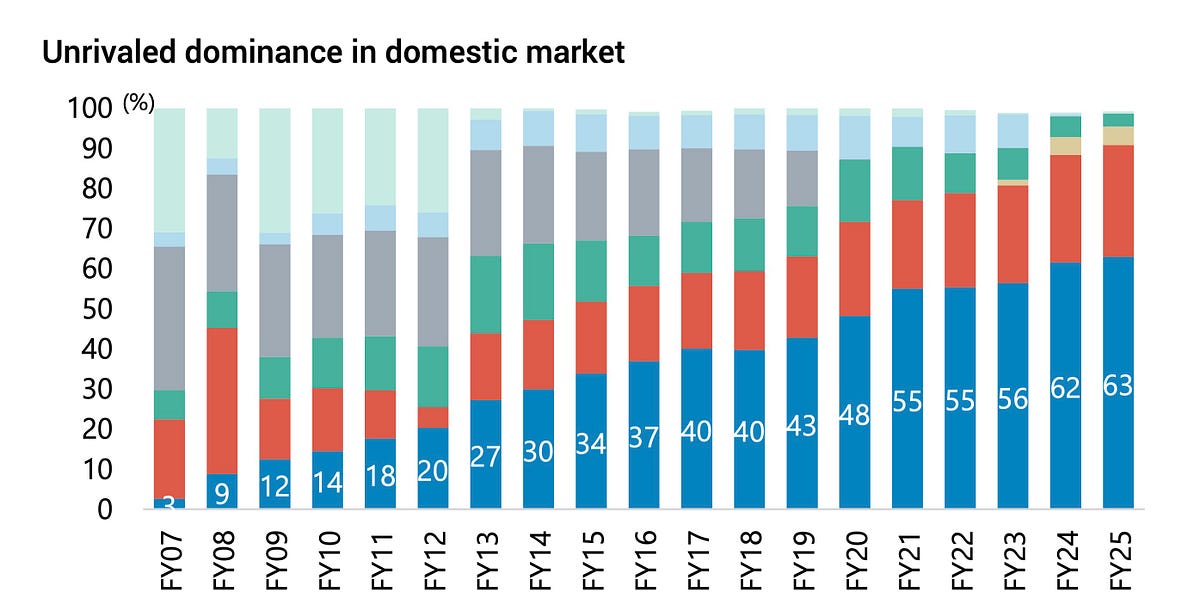
India's domestic aviation market is dominated by IndiGo, holding a staggering 64.4% market share. This dominance, achieved through a decade of expansion and the struggles of competitors like SpiceJet and Air India, sees IndiGo holding a near-monopoly on 66% of its routes. Despite slowing demand and price pressures, IndiGo's low-cost model and international expansion strategy are strengthening its position. However, navigating reduced demand and pricing power from a near-monopolistic position presents significant challenges.

Read more

AI Teammate: Field Experiment Shows Generative AI Reshaping Teamwork and Expertise

2025-03-22
AI Teammate: Field Experiment Shows Generative AI Reshaping Teamwork and Expertise

A randomized controlled trial at Procter & Gamble reveals generative AI significantly boosts team productivity and solution quality. Individuals with AI performed as well as teams without, while AI-enabled teams excelled, significantly increasing the likelihood of top-tier solutions. AI not only improved efficiency but also enhanced positive emotions, bridged departmental silos, and enabled less experienced employees to reach the performance levels of experienced team members. This research suggests AI is not merely a productivity tool, but a 'teammate' capable of reshaping teamwork and organizational structures.

Read more
AI

Small but Mighty: Exploring the Beauty of Concise Programming Languages

2025-06-06

This article explores the trade-off between the size and expressiveness of programming languages. The author argues that smaller languages like assembly are limited in expressiveness, while languages like Forth, Lisp, and Tcl achieve powerful expressiveness with concise syntax. Lua is highlighted as a small and easy-to-learn language due to its tiny core (just 27 pages!). The impact of standard libraries on perceived language size is discussed, with Ramda's extensive functionality used as an example of increased learning curve. Ultimately, the author champions the elegance and joy of small languages, suggesting that simplicity can sometimes trump expressiveness.

Read more
Development conciseness

Share Docker Images as Executables

2025-05-07
Share Docker Images as Executables

Introducing `docker2exe`, a tool that converts Docker images into self-contained executables for easy sharing! It's cross-platform compatible, requiring Docker, GoLang, and gzip on the build machine, and only Docker on the execution machine. Usage is straightforward: `docker2exe --name alpine --image alpine:3.9` creates an executable. It also supports embedding the image within the executable, automatically pulling and running it if the image isn't found on the target machine. This is especially useful for smaller images. The resulting executables are typically under 10MB.

Read more
Development Executable Image

WebGL Viewer for Sparse Voxel Scenes

2025-04-09
WebGL Viewer for Sparse Voxel Scenes

An interactive WebGL viewer for visualizing sparse voxel scenes from the Nvidia Sparse Voxels Rasterization paper. This viewer lets you explore and visualize the voxel radiance field from your web browser. Rendering is similar to the reference CUDA implementation. It features interactive camera controls (mouse and touch), performance metrics display (FPS), and supports loading custom PLY files. The project leveraged AI assistance, proving highly efficient for boilerplate code but less so for complex graphics debugging. Generated PLY files can be large; consider limiting voxel count.

Read more
Development Voxel Rendering

Swift Interop with Erlang's Distributed Actors: A Seamless Solution

2025-07-23
Swift Interop with Erlang's Distributed Actors: A Seamless Solution

A new actor system, `swift-erlang-actor-system`, enables Swift programs to seamlessly integrate with Erlang's distributed clusters. By wrapping Erlang's C node functionality, developers can use Swift's distributed actors to communicate with Erlang nodes. The system cleverly uses the @StableNames macro to address name mangling issues in cross-language remote calls and supports custom transport protocols. This provides an elegant solution for Swift and Erlang interoperability and paves the way for running Elixir applications on iOS and other Apple platforms.

Read more
Development Distributed Actors

The Enduring Legacy of the 88x31 Pixel Button

2025-04-05

This article delves into the origins and enduring popularity of the ubiquitous 88x31 pixel button on the internet. Tracing its roots back to the mid-1990s, the article explores how Netscape's "Netscape Now" program utilized this button size, later leading to widespread adoption on platforms like Geocities. Despite its small size, its ease of creation, distribution, and customization made it a unique symbol of early web culture. Even in today's high-resolution screen era, the 88x31 pixel button persists, tied to nostalgia and a distinct aesthetic of the early internet. The article also explores alternative button sizes and offers perspectives on the future of the 88x31 pixel button.

Read more
Design

CES 2025: The Worst Tech of the Year

2025-01-11
CES 2025: The Worst Tech of the Year

At CES 2025, the "Worst in Show" awards highlighted the most troubling trends in tech, focusing on privacy violations, security flaws, poor repairability, and unsustainable practices. Judges evaluated products based on severity of issues, innovative badness, global impact, comparison to previous iterations, and the balance between positives and negatives. The awards served as a wake-up call, showcasing the concerning direction of certain technological advancements.

Read more
Tech

Snake Game in Four Integers: A Memory Minimization Challenge

2025-07-06

A developer took on the challenge of implementing a Snake game using only four integers (uint32_t*2, uint64_t, int8_t), cleverly packing game map, snake body, apple position, and direction into them. Macros are used extensively for bitwise operations, resulting in concise but less readable code. This project showcases extreme memory optimization at the cost of maintainability and readability. The code is open-source, and interested developers can try compiling and running it to experience this unique programming art.

Read more

Microsoft Edge Launches Copilot Mode: AI-Powered Browsing Reimagined

2025-07-29
Microsoft Edge Launches Copilot Mode: AI-Powered Browsing Reimagined

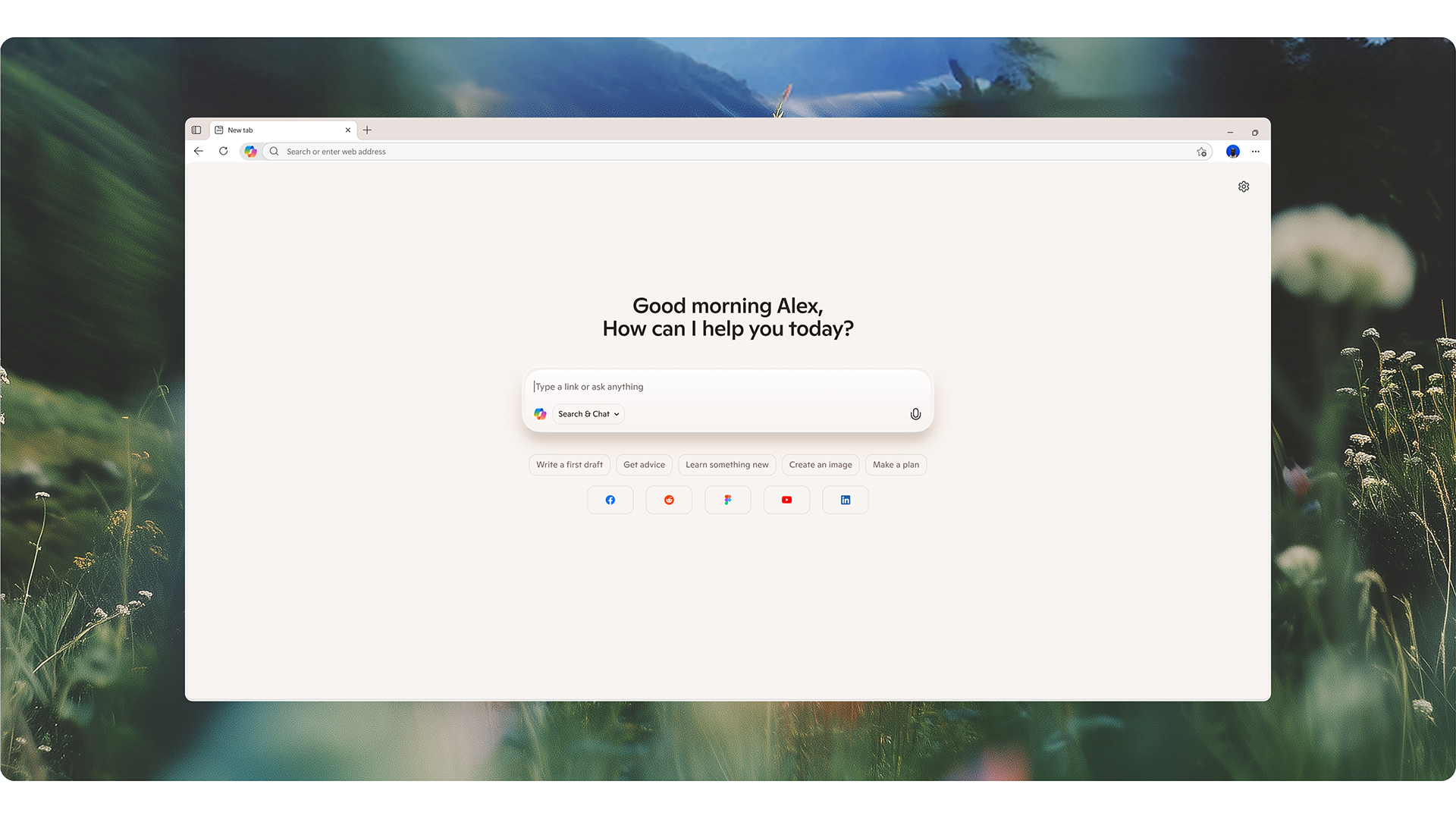
Microsoft has released Copilot Mode for its Edge browser, an experimental feature leveraging AI to redefine web browsing. Copilot Mode integrates search, chat, and navigation into a single input box, understanding user intent for faster browsing. It analyzes context across open tabs, aiding in comparison, decision-making, and task completion. Copilot supports voice navigation and advanced actions (with user permission) accessing browser history and credentials for enhanced efficiency. Future improvements and features are planned, with the option to disable Copilot Mode in settings.

Read more
Tech
1 2 271 272 273 275 277 278 279 596 597