Category: Development

The Illustrated Guide to a PhD: A Visual Journey

2025-01-12

This article visually explains the PhD journey. Knowledge is represented as a circle, and a PhD is depicted as pushing the boundaries of that circle, making a dent representing the contribution of original research. The author uses simple diagrams to illustrate the stages involved, from undergraduate studies to the final breakthrough. The article emphasizes perseverance and the importance of seeing the bigger picture.

Why I Ditched Clojure for Common Lisp

2025-01-12

After seven years with Clojure, a programmer switched to Common Lisp due to frustrations with slow startup times and difficulties creating native executables. Key factors in his decision included the need for fast, standalone executables, Vim compatibility, cross-platform support, robust multithreading, and a vibrant community with a rich ecosystem. Common Lisp ultimately won out due to its mature tooling, powerful CLOS and Conditions system, and fast runtime.

Development

C's Overlooked Improvements: Compile-Time Function Execution and Module Importing

2025-01-12

This article highlights long-standing shortcomings in C, such as the inability to execute functions at compile time, redundant declarations, and cumbersome header file management. The author, leveraging ImportC (a C compiler embedded within the D language compiler), demonstrates solutions to these issues. These include enabling compile-time function execution for unit testing, allowing arbitrary ordering of global declarations, and the ability to directly import C source files. These improvements significantly enhance development efficiency and code maintainability, showcasing the potential of modern compiler technology to address historical C language limitations.

Development

Pagecord: Effortlessly Publish Writing from Your Inbox

2025-01-12
Pagecord: Effortlessly Publish Writing from Your Inbox

Pagecord is a Ruby on Rails application that lets you effortlessly publish your writing to your website by simply sending an email. It streamlines the writing and publishing process, automating the steps typically involved in editing and uploading content. The open-source project, hosted on GitHub, provides comprehensive documentation and testing instructions.

Development writing tool

Aussie Engineer's Take on Working for US Tech Firms: Time Zones, Culture, and Stability

2025-01-12

An Australian engineer shares his decade-long experience working for American tech companies. He details the challenges of cross-timezone collaboration: mornings are spent catching up on overnight work, but afternoons offer invaluable focused time. While loneliness can be an issue, strong teamwork and documentation culture mitigate this. He also notes the inherent instability of working for a US company from abroad, but highlights the larger scale, better compensation, and higher brand recognition as key motivators. Finally, he discusses cultural differences between Australia and the US, where Americans are more enthusiastic and Australians more understated, requiring adaptation to the American work culture.

Development cross-cultural work

Stop Trying to Schedule Calls With Me!

2025-01-12
Stop Trying to Schedule Calls With Me!

The author vents frustration with the SaaS sales process: from initial trial emails to endless demo calls and contract negotiations, it's a time-wasting, inefficient ordeal. Sales reps focus solely on closing deals, engineers are overworked, and the user experience suffers. The author calls for SaaS companies to improve their sales tactics, minimize unnecessary communication, and enhance user experience.

Development Sales

FSF: Guardians of Software Freedom

2025-01-11

Since its founding in 1985, the Free Software Foundation (FSF) has been a steadfast advocate for software freedom, resisting the encroachment of commercial interests. Its unique non-member governance structure ensures its mission remains uncompromised, weathering challenges from the 'open source' movement and corporate influence to uphold software freedom as a fundamental human right.

WordPress Founder Deactivates Accounts of Contributors Planning a Fork

2025-01-11
WordPress Founder Deactivates Accounts of Contributors Planning a Fork

WordPress creator Matt Mullenweg deactivated the accounts of several WordPress.org community members involved in efforts to create a fork of the open-source project. The conflict stemmed from a dispute with WP Engine, a commercial hosting company criticized for insufficient community contribution. Following this, key community figures like Joost de Valk (Yoast) and Karim Marucchi (Crowd Favorite) expressed concerns about WordPress governance, hinting at a potential fork. Mullenweg, ostensibly to support their independent efforts, deactivated their accounts and others, sparking controversy.

Development Community Governance

Cursor's Clever Algorithm: Character Prefix Conditioning for Accurate Code Completion

2025-01-11
Cursor's Clever Algorithm: Character Prefix Conditioning for Accurate Code Completion

Cursor's blog post dives into a crucial problem in AI code completion: handling character prefixes effectively. Traditional token-based sampling fails when the cursor isn't on a token boundary. The post introduces character prefix conditioning, an algorithm that samples based on character prefixes, ensuring completions start with user input. The post concludes with a challenge: devise an efficient algorithm to sample from this distribution while minimizing calls to the underlying language model.

Development Code Completion

CubeTrek: 3D Visualization for Your GPS Tracks

2025-01-11
CubeTrek: 3D Visualization for Your GPS Tracks

CubeTrek is a web-based platform for visualizing, sharing, and managing your GPS tracks. Breaking free from the limitations of 2D maps, it utilizes Babylon.js to create an interactive 3D terrain view, offering a more intuitive way to experience the thrill of outdoor activities. Supporting data import from Garmin, Polar, and Coros watches, CubeTrek combines NASA SRTM data and OpenStreetMap data to provide rich statistics and activity analysis, even automatically identifying the peaks you've climbed. The backend is built with Java and Spring Boot, while the frontend leverages technologies like Bootstrap, D3.js, and MapLibre GL JS.

Lovable's 19-Hour Outage: A GitHub App Debacle

2025-01-11
Lovable's 19-Hour Outage: A GitHub App Debacle

Lovable experienced a nearly 19-hour outage due to GitHub disabling its app for violating terms of service related to rapid repository creation. The app was crucial for cloning and pushing user repositories. Lovable swiftly responded by implementing a more scalable file storage solution using AWS S3 for new projects, and eventually restored service after GitHub reinstated the app. The incident highlighted Lovable's need for improved dependency management, faster response times to outages, and stronger vendor communication. Improvements include implementing a paging system for critical alerts and migrating to a more robust analytics database.

CCL: A Minimalist Configuration Language Based on Category Theory

2025-01-11
CCL: A Minimalist Configuration Language Based on Category Theory

The author presents CCL, a minimalist configuration language inspired by Category Theory. CCL's core is key-value pairs, eschewing complex features in favor of composability and extensibility. Clever use of whitespace and simple rules handle nested structures and comments, enabling powerful features like lists, comments, sections, and multiline strings while maintaining extreme simplicity. A unique fixed-point design elegantly solves key override conflicts. Leveraging monoids and monoid homomorphisms from Category Theory ensures correct and efficient configuration composition. CCL's code is concise, easily understood, and readily implemented, making it a valuable example of elegant software design.

The Browser: A New Medium for Storytelling

2025-01-11
The Browser: A New Medium for Storytelling

This article explores the potential of the browser as a novel medium for adapting stories. Using J.R.R. Tolkien's Lord of the Rings as an example, it highlights how different mediums shape storytelling. The author argues that the browser, with its versatile tools (text, images, video, sound, interactivity), offers richer, more dynamic, and personalized narrative experiences. A prototype interactive adaptation of Lord of the Rings is showcased, demonstrating how browser technology enhances reader immersion and engagement through features like maps, character sheets, and sound design, creating a compelling user experience.

Free Alt Text Checker: Boost Website Accessibility and SEO

2025-01-11

This free Alt Text Checker tool helps you quickly verify if your website images include alt text. Alt text improves website accessibility for visually impaired users and boosts search engine optimization (SEO). The tool automatically scans web pages, finds missing alt text descriptions, and generates a report to help you improve your site's inclusivity and user-friendliness.

DockView: Zero-Dependency Docking Layout Manager for React, Vue, and TypeScript

2025-01-11
DockView: Zero-Dependency Docking Layout Manager for React, Vue, and TypeScript

DockView is a zero-dependency docking layout manager supporting tabs, groups, grids, and split views. It works with React, Vue, and vanilla TypeScript. Features include serialization/deserialization, theming, drag-and-drop, popout windows, floating groups, a comprehensive API, and high test coverage. Built with security in mind, DockView uses GitHub Actions for verified publishing and builds. It boasts excellent documentation and live examples, making it a powerful and easy-to-use layout management solution.

Development Layout Manager

PrivTracker: One-Click Private BitTorrent Tracker

2025-01-11

PrivTracker lets you create a private BitTorrent tracker with a single click. Share torrent files securely with only your friends; no public exposure. It works by using a unique announce URL that restricts peer sharing to your group. The instructions include easy-to-follow guides for using Transmission on Linux and macOS. Simply generate the announce URL, add it to your torrent, and share with your friends for private and secure file sharing.

Txtlog: An Easy-to-Use Open Source Log Service

2025-01-11

Txtlog.net is a simple and easy-to-use text log service that doesn't require an account to get started. It supports various log formats (valid JSON, invalid JSON, or raw text), offering fault tolerance and a clean dashboard. Txtlog automatically performs Geo IP checks and provides a secure, high-performance queue based on Redis Streams. All code is open source under the permissive MIT license. For enhanced security, users can optionally set a username and password and remove the public view link.

Autoscaling Your Kubernetes Apps with Dash0: Beyond CPU and Memory

2025-01-11
Autoscaling Your Kubernetes Apps with Dash0: Beyond CPU and Memory

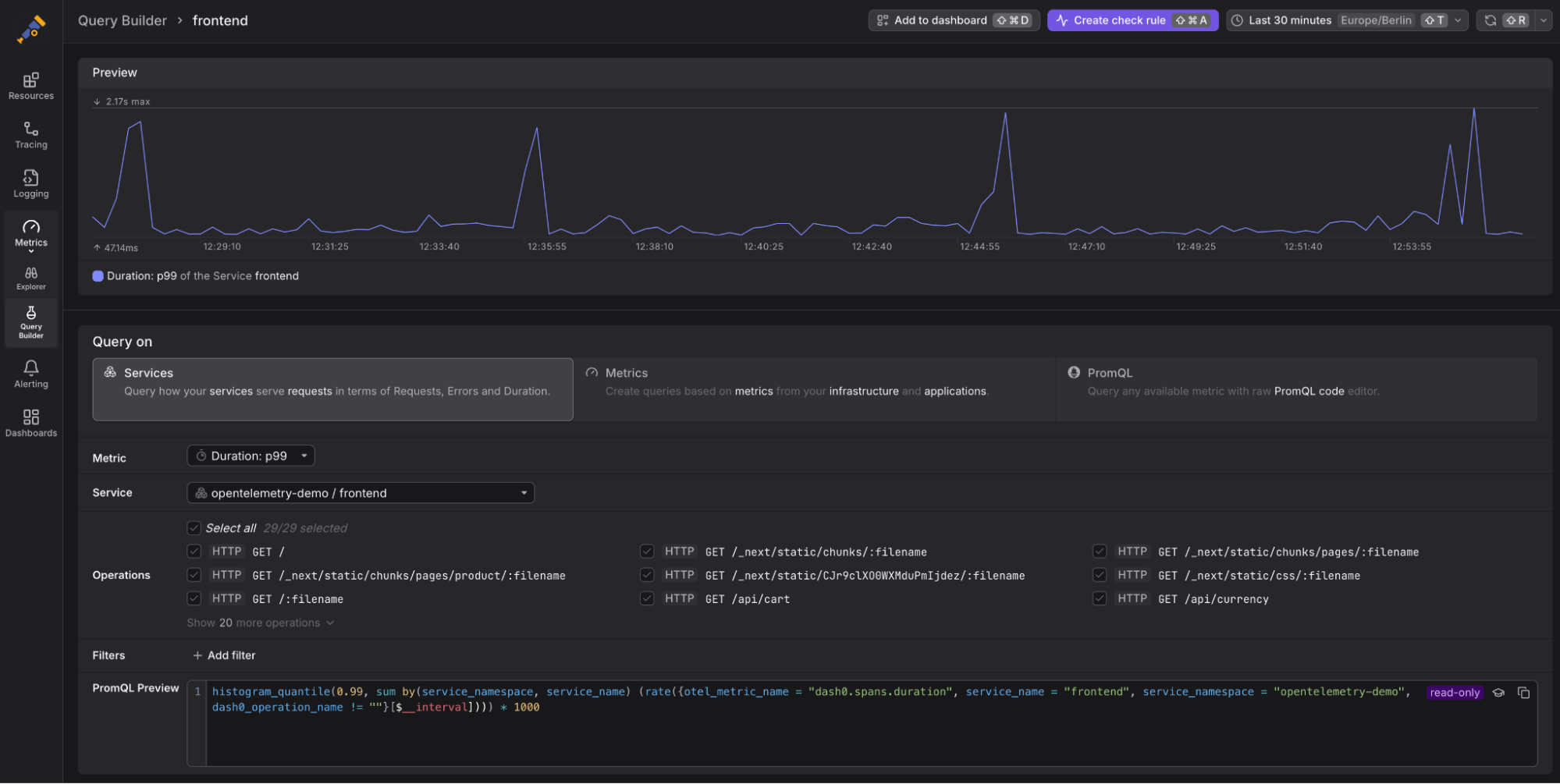
This blog post demonstrates how to leverage Dash0 for automated scaling of Kubernetes applications. While Kubernetes simplifies scaling, manual replica adjustments are inefficient. Dash0 automates this process by monitoring application telemetry. The post explores three Kubernetes autoscaling types: Horizontal Pod Autoscaling, Vertical Pod Autoscaling, and Cluster Autoscaling, focusing on Horizontal Pod Autoscaling. It explains its mechanics and how to utilize custom metrics (like latency) instead of solely relying on CPU and memory utilization for optimal scaling strategies. Dash0 integrates with the Prometheus Adapter, enabling PromQL queries against Dash0 data to drive HPA, resulting in automated scaling based on application performance and improved user experience.

Development Autoscaling

Sony Pushes for C++20 as LLVM Clang's Default

2025-01-11

Sony engineers are proposing a change to the default C++ mode in the LLVM Clang compiler, switching from C++17 to C++20. This aligns with Sony's upcoming plans to make C++20 the default for their PlayStation 5 compiler. While some C++20 test cases currently fail and Clang's C++20 support isn't yet complete, Sony intends to contribute a build/test bot to assist upstream development. This initiative aims to accelerate Clang's adoption of C++20, leading to a more efficient compilation environment for game development.

Development

Track Bluetooth Devices via Apple's Find My Network with Go

2025-01-11
Track Bluetooth Devices via Apple's Find My Network with Go

Go Haystack leverages OpenHaystack and Macless-Haystack to track personal Bluetooth devices using tools written in Go/TinyGo. It supports various Bluetooth hardware, including Adafruit Bluefruit and BBC micro:bit, and includes TinyScan for local device scanning. Users need an Apple ID with 2FA enabled and must set up anisette-v3-server and macless-haystack. Device information will eventually appear in the Macless-Haystack web UI.

Development Bluetooth tracking

Linux Hearing Aid Audio Streaming: An Open Source Breakthrough

2025-01-11

Asymptotic.io has achieved a significant breakthrough by enabling native support for the ASHA protocol on Linux, bringing accessibility improvements for Linux users with hearing aids. This multi-year project, from proof-of-concept to integration into BlueZ and PipeWire, solves a long-standing problem. The project not only enhances accessibility on Linux but also showcases the power of open source and the expertise of the Asymptotic.io team. Future plans include adding stereo support and extensive testing for reliability and stability.

Development hearing aids

Vim's Rebirth After Bram Moolenaar's Passing

2025-01-11

The death of Bram Moolenaar, Vim's creator, shook the community, but the project lives on. At VimConf 2024, new maintainer Christian Brabandt outlined the project's reorganization and future plans. The team expanded, the website and infrastructure were upgraded, security vulnerability reporting and community communication were addressed. While Vim is currently in maintenance mode, development hasn't stopped; version 9.1 was released, with plans to improve the GUI, terminal support, and spell checking. Community collaboration is crucial; Brabandt emphasized listening to user needs and maintaining a healthy community.

Development Community Maintenance

Black Magic: A Blazing Fast Circular Buffer

2025-01-11

This article presents a clever optimization of circular buffers using virtual memory paging. Traditional circular buffer read/write operations are inefficient due to boundary handling. The author uses the `mmap` system call to map the buffer to two contiguous virtual memory regions. This allows writes to proceed continuously without boundary checks, drastically improving performance. This method leverages the OS to handle wrap-around automatically, eliminating complex boundary checks and modulo operations. The result is a threefold performance increase.

OMG! Nearly All Binary Searches and Mergesorts Are Broken

2025-01-11
OMG! Nearly All Binary Searches and Mergesorts Are Broken

Google software engineer Joshua Bloch revealed a nearly two-decade-old bug lurking in binary search algorithms, found in both the JDK and Jon Bentley's 'Programming Pearls'! The bug stems from the line `int mid = (low + high) / 2;`, causing integer overflow and array index out-of-bounds exceptions when the sum of `low` and `high` exceeds the maximum positive integer value. This bug only manifests with massive datasets, making it particularly dangerous in today's big data world. The article explores various fixes and emphasizes that bugs can persist even with rigorous testing and proofs, urging programmers to remain cautious and humble.

C++26: The Unnamed Placeholder `_` Arrives

2025-01-11

C++26 introduces a game-changing feature: the unnamed placeholder `_`. This solves a long-standing annoyance in C++: handling unused variables. Previously, developers needed `[[maybe_unused]]` or `std::ignore` to avoid compiler warnings, especially with structured bindings. The `_` placeholder can be declared multiple times without conflict and implicitly has the `[[maybe_unused]]` attribute, simplifying code and improving readability. This feature is already implemented in GCC 14 and Clang 18.

NearlyFreeSpeech.NET: A DIY Hosting Service for Geeks

2025-01-11

NearlyFreeSpeech.NET is a do-it-yourself web hosting service designed for experienced webmasters and highly self-motivated individuals. It operates on a pay-for-what-you-use model, meaning you only pay for the resources you consume. While lacking in personal technical support, it offers extensive documentation and community support, making it a cost-effective option for those comfortable managing their own websites. Services include web hosting, DNS hosting, and domain registration, with support for various programming languages and databases.

Bash Has Hashmaps?!

2025-01-11

This blog post reveals a hidden gem in bash scripting: built-in support for hashmaps (associative arrays)! The author, while working on a project involving GPU instance management, discovered this feature and shares how to use it. The post details how to declare, assign values to, read, iterate over, and delete key-value pairs within a bash hashmap, showcasing two declaration methods: dynamic addition and pre-defined key-value pairs. This is a valuable technique for efficiently handling key-value data within bash scripts.

The Makefile Effect: Why We Copy-Paste Config Files

2025-01-11

This post explores the common "Makefile effect" in software engineering: engineers tend to copy-paste and tweak existing configuration files (like Makefiles, CI/CD configurations, etc.) instead of writing them from scratch. The author argues this isn't inherently bad, but suggests it indicates that tools might be overly complex, lacking good diagnostics and debugging support, making them inefficient and insecure to use. The post concludes with design recommendations to minimize this effect, improving development efficiency and security.

Development tool design

XYplorer: A Top-Rated File Manager Written in 'Dead' VB6

2025-01-11

XYplorer, a globally popular file manager, is surprisingly written in the outdated VB6 programming language. The article addresses the misconception that VB6 is inherently inferior, showcasing XYplorer's efficiency and extensive features as proof. While acknowledging limitations like the lack of multi-threading and 64-bit compilation, the author argues that these don't detract from its widespread use and positive reviews. Using the analogy of a coffee machine, the piece highlights that a product's functionality and performance outweigh the language it's built in.

Development file manager
1 2 187 188 189 191 193 194 195 214 215