Category: Development

Rust Reflection: The Tug-of-War Between Safety and Access Rules

2025-01-03

Rust lacks reflection, a feature many developers desire. This article delves into the safety challenges of implementing reflection in Rust. Due to Rust's memory safety guarantees, a reflection API must adhere to strict access rules, preventing arbitrary access to private fields to avoid memory safety vulnerabilities. The author explores how these limitations impact reflection API design, such as handling reflection failures and expressing complex reflection bounds. The trade-offs between safe and unsafe reflection APIs are also discussed, along with balancing functionality and security. Ultimately, creating a safe reflection mechanism in Rust is a complex and challenging problem requiring careful consideration of various factors.
Development Reflection

SQLFlow: Stream Processing with DuckDB and SQL

2025-01-03
SQLFlow: Stream Processing with DuckDB and SQL

SQLFlow is a stream processing engine powered by DuckDB, enabling SQL-based operations on real-time data from sources like Kafka and webhooks. It supports data transformations, enrichment, aggregation, tumbling window aggregations, and outputs to destinations such as Kafka, databases, or local files. SQLFlow boasts high throughput, handling tens of thousands of messages per second, and supports custom serialization and encoding. Docker deployment is readily available for easy setup.

Development stream processing

Playing Catch-Up: Val Town's Journey Building an AI Code Assistant

2025-01-03
Playing Catch-Up: Val Town's Journey Building an AI Code Assistant

Val Town's AI code assistant, Townie, has been a journey of chasing the leaders – GitHub Copilot, ChatGPT, Claude, and others. Starting with simple code completion, it evolved to generating full-stack apps using tool calling. This article recounts Townie's development, highlighting efforts in speed improvements, automatic error detection, and differentiated competition. It also looks ahead to integrating more advanced features.

Development fast iteration

Overcoming Resistance to Extreme Programming: A Manager's Guide

2025-01-03
Overcoming Resistance to Extreme Programming: A Manager's Guide

This article explores the common resistance encountered when teams adopt Extreme Programming (XP). The author argues that forcing change is counterproductive; XP's success lies in team autonomy. Resistance stems from developer misconceptions about XP, managerial incentive structures, and the tools themselves. The author advises managers to empower teams, create space for experimentation, and help overcome resistance through shared experiences, hands-on practice, and accountability. The ultimate goal is achieving highly effective collaboration and joyful work.

TurboGist: Streamlining Code Sharing for Developers

2025-01-03

TurboGist is a simple and efficient code-sharing platform designed to solve the pain points of sharing code in team collaborations. It eliminates the cumbersome copy-pasting and reliance on third-party tools, offering real-time code sharing, syntax highlighting, code snippet notifications, and Copilot-like code completion suggestions. Developers can quickly share code without leaving their editor, boosting efficiency and allowing them to focus on coding and problem-solving.

Development

Google SRE's Evolution: From Error Budgets to Systems Theory

2025-01-03
Google SRE's Evolution: From Error Budgets to Systems Theory

Google's Site Reliability Engineering (SRE) team has undergone a significant evolution over the past 25 years. Initially relying on methods like Service Level Objectives (SLOs), error budgets, and isolation strategies, Google's SRE team has shifted towards systems theory and control theory, adopting the STAMP framework to address increasingly complex systems and emerging challenges. STAMP shifts the focus from preventing individual component failures to understanding and managing complex system interactions. This article uses a real-world case study to illustrate how STAMP helps Google prevent system-level failures and explores its future applications across the tech industry.

Development Systems Theory

Org-Supertag: Supercharging Org-mode's Tag System

2025-01-03
Org-Supertag: Supercharging Org-mode's Tag System

Org-Supertag is an Emacs Org-mode plugin that enhances Org-mode's tagging capabilities, allowing tags to not only assign attributes to nodes but also directly manipulate them for more flexible knowledge management. Inspired by Tana, it's non-intrusive and coexists seamlessly with Org-mode's existing features. It introduces 'super tags' defining node structure and behavior, supporting field and behavior systems for structured properties and automated actions. Its query system allows unified searching across nodes, tags, and fields, with multiple export options.

Development Knowledge Management

Conquering 3200 Gbps Network: A Journey with RDMA, EFA, and libfabric

2025-01-03

At Perplexity AI, the author leveraged RDMA, EFA, and libfabric on AWS p5 instances (with 8 NVIDIA H100 GPUs interconnected via NVSwitch) to achieve nearly perfect utilization (97%) of the 3200 Gbps network bandwidth. This article details the process, sharing valuable insights and optimization techniques (multi-threading, CPU core pinning, state sharding, etc.) for high-performance network programming. It highlights the advantages of asynchronous communication models over collective communication methods.

The Joy of Coding: Finding Balance in Passion

2025-01-03
The Joy of Coding: Finding Balance in Passion

The author, a lifelong coder, shares his perspective on the delicate balance between passion and obsession. He loves coding and often works on projects nights and weekends, finding immense joy in it. However, he cautions against letting this passion become an unhealthy obsession, neglecting other important aspects of life like relationships and rest. The author emphasizes the importance of maintaining multiple interests, regularly assessing one's well-being, and avoiding imposing personal work habits on others. He advocates for a balanced approach, where passion fuels creativity without consuming one's entire life.

(tej.as)

PWCT2: Visual Programming Without Coding

2025-01-03
PWCT2: Visual Programming Without Coding

PWCT2 is a second-generation visual programming language written in Ring, designed for enjoyable visual programming and interactive visualizations. It supports importing and exporting Ring code and runs on Windows, Linux, and macOS. Available on Steam, PWCT2 boasts a wide range of features covering web development, 2D game development, and more, along with extensive tutorial videos and documentation.

Development Ring language

In Memoriam: Noah Gibbs, a Ruby Titan

2025-01-03

The Ruby community mourns the loss of Noah Gibbs, a true giant in the field. This heartfelt tribute recounts the author's collaboration with Noah, from online interactions to working side-by-side on projects like Scarpe. Noah wasn't just a brilliant engineer; he was a passionate mentor, generously sharing his expertise and inspiring countless others. His contributions to Scarpe, including significant code and design, are a testament to his dedication. While his passing is a profound loss, his legacy of mentorship and innovative spirit will continue to inspire the community.

Development In Memoriam

Types: The Foundation of Software Design

2025-01-03
Types: The Foundation of Software Design

Software design is more than just writing functions; it's about high-level architecture. This article argues that types are the most crucial element. Types define data structures and function interfaces, key to understanding and communicating software design. Even in dynamically typed languages, types exist implicitly. Good type design improves code readability, maintainability, and reliability, aiding abstraction and modularity. The article explores differences between static and dynamic typing and how various type systems (like generics and dependent types) impact design.

Benchmarking RSA Key Generation: A Battle Against Probability

2025-01-03
Benchmarking RSA Key Generation: A Battle Against Probability

RSA key generation, while conceptually simple, is notoriously difficult to implement and benchmark. This article cleverly uses mathematical methods to overcome the noisy results typical of statistical approaches. By pre-generating a representative sequence of candidate numbers, the author provides a more stable and reliable benchmarking methodology for comparing different implementations. The article details the mathematical underpinnings of RSA key generation and shares the script and data used to generate the average candidate sequence, facilitating testing and comparison by readers.

CoinTracker Hiring Full-Stack Product Engineer

2025-01-03
CoinTracker Hiring Full-Stack Product Engineer

Cryptocurrency tracking platform CoinTracker is hiring a Full-Stack Product Engineer. This is an exciting opportunity to join a rapidly growing team and make an impact on the future of the cryptocurrency space. The role requires experience in full-stack development, familiarity with various programming languages and frameworks, and some understanding of blockchain technology. If you're passionate about cryptocurrency and eager to work in a challenging environment, this is the ideal position for you.

Development

Can Iterative Prompting Make LLMs Write Better Code?

2025-01-03
Can Iterative Prompting Make LLMs Write Better Code?

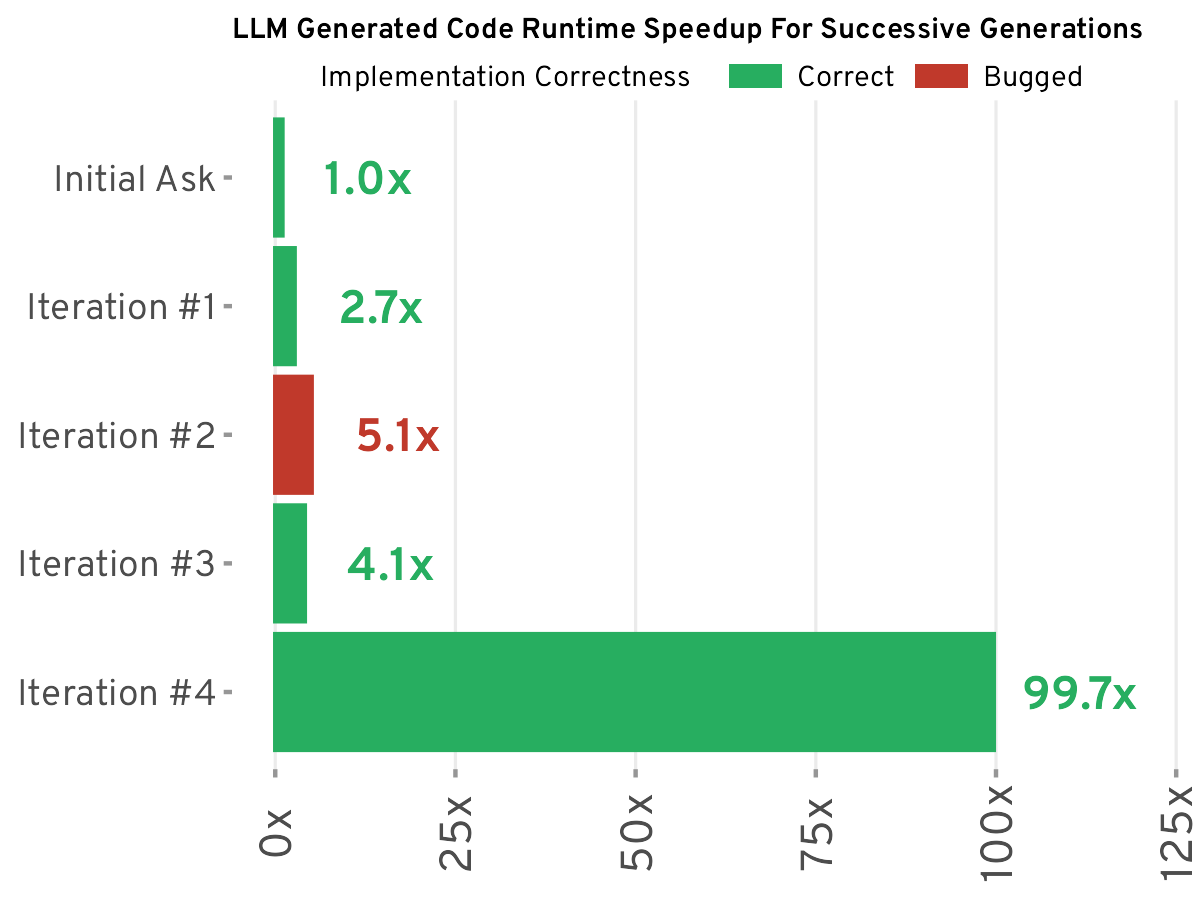
This blog post details an experiment exploring whether repeatedly prompting a Large Language Model (LLM) to "write better code" improves code quality. Using Claude 3.5 Sonnet, the author starts with a simple Python coding problem and iteratively prompts the LLM. Performance improves dramatically, achieving a 100x speedup. However, simple iterative prompting leads to over-engineering. Precise prompt engineering yields far more efficient code. The experiment shows LLMs can assist code optimization, but human intervention and expertise remain crucial for quality and efficiency.

Code Rewrites: Magic Wand vs. Iterative Improvement

2025-01-03

This article explores the pros and cons of code rewrites. Using Netscape's failure as an example, the author argues that rewriting isn't always the best approach. Instead of large-scale rewrites, maintain idealism, imagine a perfect solution (wave a magic wand), and then iteratively improve the existing code. By distinguishing between necessary and accidental complexity, identify improvement directions and continually reflect on "If I could wave a magic wand, what would I want it to be?", ultimately reaching the ideal state.

Gource: Visualizing Your Codebase with Stunning Animations

2025-01-03
Gource: Visualizing Your Codebase with Stunning Animations

Gource is an open-source software that visualizes your version control repository history in a breathtaking animated way. The repository root is at the center, directories are branches, files are leaves, and developers become dynamic characters moving around the code tree, their contributions shown as animated trails. Gource uses OpenGL rendering and requires a 3D-accelerated video card. It supports various version control systems like Git, SVN, Mercurial, and offers extensive parameters for customization, allowing you to easily generate impressive visualizations of your codebase history.

Development code visualization

Control Your Roku with Hand Gestures: A Python and MediaPipe Project

2025-01-03
Control Your Roku with Hand Gestures: A Python and MediaPipe Project

HandiRokuRemote lets you control your Roku using hand gestures! This Python project uses Google's MediaPipe for real-time hand tracking, translating gestures into commands sent to your Roku via its External Control Protocol (ECP). The intuitive interface features automatic device discovery, customizable settings (debug mode, auto-start, skeleton view), and a range of supported gestures for navigation and media control. While current limitations exist regarding hand detection distance, future development aims to expand compatibility to other smart TVs and HDMI-CEC enabled devices.

Kuvasz-streamer: High-Performance PostgreSQL CDC

2025-01-03

Kuvasz-streamer is an open-source change data capture (CDC) project exclusively for PostgreSQL. Tightly integrated with PostgreSQL Logical Replication, it delivers high-performance, low-latency replication. Features include a lightweight design (Go, no dependencies), high throughput (10K TPS, <1s latency), automated publication and slot management, flexible table propagation models (clone, history, append-only), and support for declarative and interactive modes. Use cases span data consolidation, database upgrades, microservice database consolidation, multi-tenant database consolidation, and database performance optimization.

Development Data Replication

Be a Property Owner, Not a Renter, on the Internet

2025-01-03
Be a Property Owner, Not a Renter, on the Internet

The internet of 2025 is drastically different from the early 2000s, dominated by a few mega-corporations. This post argues for tech-savvy individuals to own their online presence rather than renting space from large platforms. The author advocates for owning your domain and website, diversifying your online presence across multiple networks, and prioritizing email lists. While engagement on other platforms is encouraged, it shouldn't be solely for link-farming; meaningful community interaction is key. The ultimate goal is to build flexible, controllable digital assets, rather than being beholden to platform policies.

Awesome Donations: A Curated List of FLOSS Projects to Support

2025-01-03
Awesome Donations: A Curated List of FLOSS Projects to Support

This GitHub repository, awesome-donations, is a curated list of donation options for numerous Free/Libre and Open Source Software (FLOSS) projects. It provides easy access to support projects ranging from large foundations like the Linux Foundation and Mozilla Foundation to individual projects such as LibreOffice, GIMP, and QEMU. Whether you prefer PayPal, credit cards, or other methods, you can easily contribute to the open-source community and help ensure the continued development of essential free software.

Development donations

Optimizing Ruby's JSON: A Tale of Stack Allocation and Inlining

2025-01-02

This blog post, part four in a series on optimizing Ruby's JSON performance, details the author's journey in improving Ruby's JSON serialization speed. Through meticulous micro-benchmarking and profiling, the author explores stack allocation and inlining techniques. By shifting buffer allocation from the heap to the stack and strategically using inlining, significant performance gains are achieved. However, the article highlights the importance of balancing micro-benchmark improvements with real-world application performance, showcasing a case where optimization negatively impacted larger datasets.

Development

The Magical Coding Interview: A Tale of Prolog, Lisp, and µKanren

2025-01-02

Seasoned programmer Vidrun faces an unconventional interview. Aisha, a three-year veteran engineer, eschews typical questions, instead engaging Vidrun in a coding duel using Prolog and the lambda calculus. Aisha guides Vidrun in building a Lisp interpreter, culminating in Vidrun's clever use of µKanren and custom macros to solve the problem, forging a connection with Aisha through the shared art of coding. This story blends technical prowess with magical realism and interpersonal dynamics, showcasing the ingenuity and artistry of programming.

Beyond RAG: A Knowledge Management System That Enhances, Not Replaces, Thought

2025-01-02
Beyond RAG: A Knowledge Management System That Enhances, Not Replaces, Thought

This article explores the design philosophy behind Zettelgarden, a knowledge management system aiming to enhance, not replace, human thought. The author recounts the evolution from paper cards to digital notes, highlighting how digital systems, while offering convenient search and linking, lose the serendipitous connections fostered by physical proximity. The author critiques the current over-reliance on automation and RAG (Retrieval Augmented Generation) models in AI-assisted knowledge management, arguing their limitations in handling massive datasets and their neglect of personal understanding and knowledge processing. Zettelgarden emphasizes the importance of personal notes, encouraging users to add commentary and insights, facilitating connections between ideas through a unique card structure. The author believes the future of knowledge management lies in human-computer collaboration, with computers handling organization and humans focusing on thinking and understanding.

Development

Go Upgrade Checklist: Lessons Learned from Upgrading 150+ Services

2025-01-02
Go Upgrade Checklist: Lessons Learned from Upgrading 150+ Services

This post details the experience of upgrading 150+ Go services from 1.17 to 1.20 at Lyft. The author stresses the importance of meticulous planning and outlines a step-by-step process including reading release notes, checking tools, running unit tests, and code linting. Automation is key, leveraging existing build, CI/CD, and deployment pipelines. Lyft completed the upgrade in 3-4 weeks with minimal production issues. The post also addresses potential pitfalls such as linter support, changes in sorting algorithms, and handling deprecated functions, highlighting the importance of a rollback plan.

Development Go upgrade

Hello World: Minimized to 167 Bytes

2025-01-02
Hello World: Minimized to 167 Bytes

This article documents the author's journey to create the smallest possible 'Hello World' program. Initially using Rust, the author discovered that minimizing the binary size required a deep dive into low-level programming. Ultimately, assembly language was chosen, and through clever techniques such as removing debugging symbols and manually crafting the ELF header, a 64-bit Linux 'Hello World' program was reduced to an impressive 167 bytes! The article delves into the file size expansion during the linking process and the details of the ELF file format, making it highly valuable for low-level system developers.

Development minimal program

Rules for Writing Kickass Software Tutorials

2025-01-02
Rules for Writing Kickass Software Tutorials

This blog post outlines rules for crafting exceptional software tutorials. It highlights the importance of avoiding jargon, clearly stating goals, providing copy-pasteable code snippets, maintaining a working code state, and minimizing dependencies. The author uses contrasting examples to illustrate the differences between good and bad tutorials, offering practical improvements such as using long command-line flags, separating user-defined values from reusable logic, and employing consistent, descriptive headings. The ultimate aim is to create beginner-friendly tutorials that are easy to understand and follow.

Notion: Your All-in-One Workspace

2025-01-02
Notion: Your All-in-One Workspace

Notion is an all-in-one workspace that combines notes, task management, wikis, and databases into a single platform. Known for its flexibility and customizability, Notion lets users create personalized workflows and knowledge bases. Whether you're a student, freelancer, or team member, Notion helps you organize information and boost productivity. Its powerful database capabilities allow you to manage everything from simple to-do lists to complex project management.

Development

7-Day Trial: Personalized AI Calendar with ChatGPT Integration

2025-01-02

A personalized AI calendar integrating ChatGPT is seeking 20 testers for a 7-day trial (minimum 3 days). This tool helps plan tasks ahead of time, providing AI-powered customized responses on the scheduled day to jumpstart creativity and overcome roadblocks. Users can refine AI responses via a 'Start Chat' feature. The trial has chat limits (10 messages/session, 100 words/message). Bookmark the link; the Discord invite is single-use. Feedback on features and UI is welcome. Fake emails are acceptable.

Development AI Calendar
1 2 194 195 196 198 200 201 202 214 215