Category: AI

Conversational Interfaces: Not the Future, but an Augmentation

2025-04-01
Conversational Interfaces: Not the Future, but an Augmentation

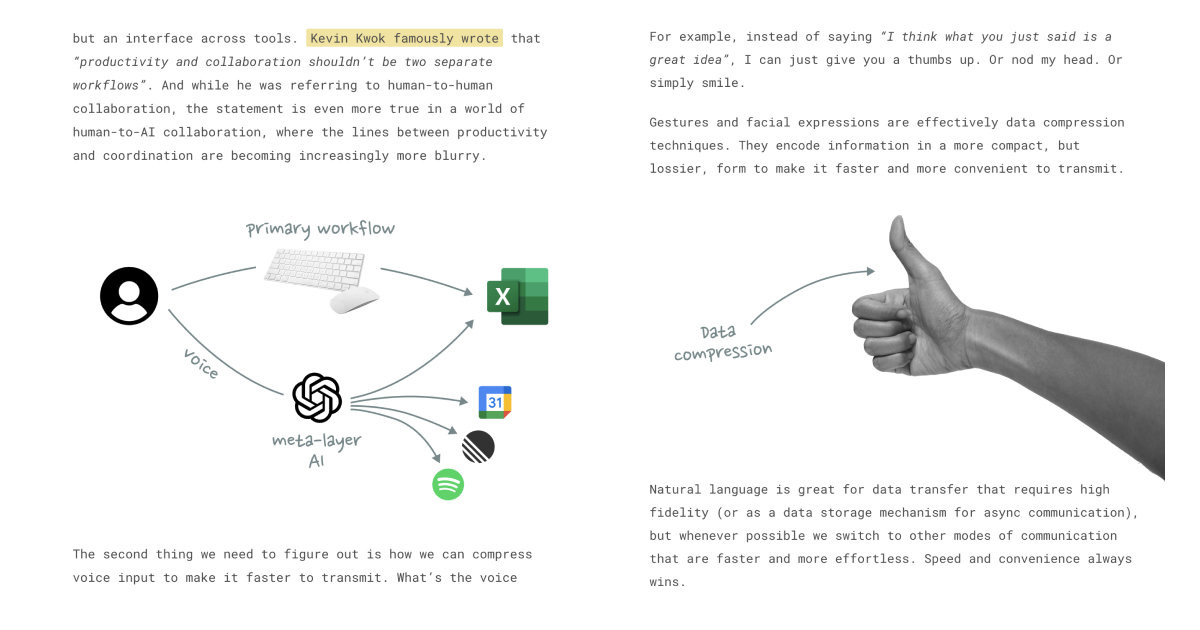
This essay challenges the notion of conversational interfaces as the next computing paradigm. While the allure of natural language interaction is strong, the author argues its slow data transfer speed makes it unsuitable for replacing existing graphical interfaces and keyboard shortcuts. Natural language excels where high fidelity is needed, but for everyday tasks, speed and convenience win. Instead of a replacement, the author proposes conversational interfaces as an augmentation, enhancing existing workflows with voice commands. The ideal future envisions AI as a cross-tool command meta-layer, enabling seamless human-AI collaboration.

AI

Ghibli-core: AI Art's Delight and Dilemma

2025-03-31
Ghibli-core: AI Art's Delight and Dilemma

OpenAI's integration of native image generation into ChatGPT unleashed a flood of Studio Ghibli-style art across social media. This sparked a debate about the future of AI, art, and attention. While the technical improvements were significant, the widespread adoption of the feature to create Ghibli-esque imagery highlighted the ease with which AI can reproduce distinct artistic styles. This led to discussions about the devaluation of artistic labor and the potential for AI to homogenize creative output. The incident underscores AI's capacity for both delight and disruption, emphasizing the growing importance of art direction in guiding AI-assisted creative processes.

DeepSeek Surpasses ChatGPT in Monthly Website Visits

2025-03-31
DeepSeek Surpasses ChatGPT in Monthly Website Visits

Chinese AI startup DeepSeek has overtaken OpenAI's ChatGPT in new monthly website visits, becoming the fastest-growing AI tool globally, according to AI analytics platform aitools.xyz. In February 2025, DeepSeek recorded 524.7 million new visits, surpassing ChatGPT's 500 million. While still third overall behind ChatGPT and Canva, DeepSeek's market share soared from 2.34% to 6.58% in February, indicating strong global adoption. Its chatbot garnered 792.6 million total visits and 136.5 million unique users. India contributed significantly, generating 43.36 million visits monthly. The overall AI industry saw 12.05 billion visits and 3.06 billion unique visitors in February.

Nova Act SDK: A Crucial Step Towards Reliable Agents

2025-03-31
Nova Act SDK: A Crucial Step Towards Reliable Agents

The Nova Act SDK simplifies the development of intelligent agents by allowing developers to break down complex workflows into atomic commands (like search, checkout, answering on-screen questions), add more detailed instructions to these commands (e.g., "don't accept the insurance upsell"), and call APIs, thus improving reliability. As intelligent agents are still in their early stages, the Nova Act SDK represents a crucial advancement.

Gemini 2.5 Pro: The New King of Code Generation?

2025-03-31
Gemini 2.5 Pro: The New King of Code Generation?

Google's Gemini 2.5 Pro, launched on March 26th, claims coding, reasoning, and overall superiority. This article focuses on a head-to-head comparison with Claude 3.7 Sonnet, another top coding model. Through four coding challenges, Gemini 2.5 Pro demonstrated significant advantages in accuracy and efficiency, especially with its million-token context window enabling complex task handling. While Claude 3.7 Sonnet performed well, it paled in direct comparison. Gemini 2.5 Pro's free access further enhances its appeal.

AI

The Internet of Agents: Building the Future of AI Collaboration

2025-03-31
The Internet of Agents: Building the Future of AI Collaboration

Agentic AI is rapidly evolving, but the lack of shared protocols for communication, tool use, memory, and trust keeps systems siloed. To unlock their full potential, we need an open, interoperable stack – an Internet of Agents. This article explores key architectural dimensions for building this network, including standardized tool interfaces, agent-to-agent communication protocols, authentication and trust mechanisms, memory and context sharing, knowledge exchange and inference APIs, economic transaction frameworks, governance and policy compliance, and agent discovery and capability matching. The author argues that shared abstractions are crucial to avoid fragmentation and enable scalable, composable autonomous systems.

A 300 IQ AI: Omnipotent or Still Bound by Reality?

2025-03-30
A 300 IQ AI: Omnipotent or Still Bound by Reality?

This article explores the limits of a super-intelligent AI with an IQ of 300 and a thought speed 10,000 times faster than a normal human. While the AI could rapidly solve problems in math, programming, and philosophy, the author argues its capabilities might be less impressive than expected in areas like weather prediction, predicting geopolitical events (e.g., predicting Trump's win), and defeating top chess engines. This is because these fields require not only intelligence but also vast computational resources, data, and physical experiments. Biology, in particular, is heavily reliant on accumulated experimental knowledge and tools, meaning the AI might not immediately cure cancer. The article concludes that the initial impact of super-AI might primarily manifest as accelerated economic growth, rather than an immediate solution to all problems, as its development remains constrained by physical limitations and feedback loops.

The Origin of LLMs: ULMFit or GPT-1?

2025-03-30

This article delves into the mystery of the origin of Large Language Models (LLMs). The author revisits the development from ULMFit to GPT-1, providing a detailed analysis of the definition of an LLM. It argues that ULMFit might be the first LLM, fulfilling key criteria such as self-supervised training, next-word prediction, and easy adaptability to various text-based tasks. While GPT-1 is widely known for its Transformer architecture, ULMFit's contribution cannot be ignored. The article also explores the future trends of LLMs, predicting that the term 'LLM' will continue to be used, evolving with the model's capabilities and potentially encompassing multimodal processing.

AI

Sonic Hedgehog Protein: A Key Player in Embryonic Development

2025-03-30
Sonic Hedgehog Protein: A Key Player in Embryonic Development

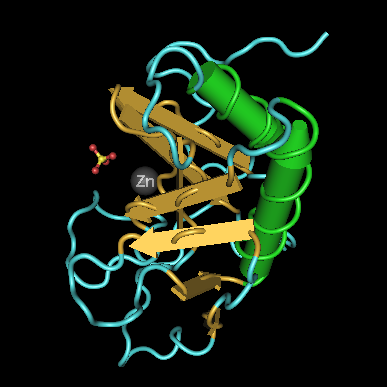
Sonic hedgehog protein (SHH), encoded by the SHH gene, is a crucial signaling molecule in embryonic development across humans and other animals. It plays a key role in regulating embryonic morphogenesis, controlling organogenesis and the organization of the central nervous system, limbs, digits, and many other body parts. SHH mutations can lead to holoprosencephaly and other developmental disorders. Abnormal SHH signaling activation in adult tissues has been implicated in various cancers. The discovery of the SHH gene stemmed from fruit fly experiments, with its name inspired by the video game character. SHH is vital in neural tube patterning, its concentration gradient determining the differentiation of various neuronal subtypes. Its role extends to lung development and has potential regenerative functions.

GATE: An Integrated Assessment Model of AI's Economic Impact

2025-03-30
GATE: An Integrated Assessment Model of AI's Economic Impact

Epoch AI presents GATE, an integrated assessment model exploring AI's economic impact. The model centers on an automation feedback loop: investment fuels computational power, leading to more capable AI systems automating tasks, boosting output, and further fueling AI development. An interactive playground lets users tweak parameters and observe model behavior under various scenarios. Predictions aren't Epoch AI's forecasts but conditional, based on assumptions, primarily useful for analyzing the qualitative dynamics of AI automation.

AI

The Regret of ChatGPT's Godfather: Has the Democratization of AI Failed?

2025-03-29
The Regret of ChatGPT's Godfather: Has the Democratization of AI Failed?

In 2017, Jeremy Howard's breakthrough in natural language processing laid the groundwork for tools like ChatGPT. He achieved a leap in AI's text comprehension by training a large language model to predict Wikipedia text. However, this technology fell under the control of a few large tech companies, leading Howard to worry about the failure of AI democratization. He and his wife, Rachel Thomas, gave up high-paying jobs to found fast.ai, dedicated to popularizing machine learning knowledge. Yet, they watched as AI technology became monopolized by a few corporations, becoming a tool for capital competition, leaving him deeply frustrated and anxious.

The Matrix Calculus You Need For Deep Learning

2025-03-29
The Matrix Calculus You Need For Deep Learning

This paper aims to explain all the matrix calculus you need to understand deep neural network training. Assuming only Calculus 1 knowledge, it progressively builds from scalar derivative rules to vector calculus, matrix calculus, Jacobians, and chain rules. Through derivations and examples, the authors demystify these concepts, making them accessible. The paper concludes with a summary of key matrix calculus rules and terminology.

ChatGPT's Songwriting: A Nick Cave-Style Disaster?

2025-03-29
ChatGPT's Songwriting: A Nick Cave-Style Disaster?

Nick Cave expresses his disdain for numerous ChatGPT-generated songs sent to him, all supposedly in his style. He argues that ChatGPT can only replicate, not create genuine, moving songs, as algorithms lack the human experience of suffering, struggle, and transcendence. True artistic creation, he contends, involves grappling with vulnerability and limitations, culminating in an emotional outpouring that AI cannot replicate. He dismisses the AI-generated songs as grotesque parodies of human creativity, bluntly criticizing their poor quality.

Robustness Testing of Medical AI Models: MIMIC-III, eICU, and SEER Datasets

2025-03-29
Robustness Testing of Medical AI Models:  MIMIC-III, eICU, and SEER Datasets

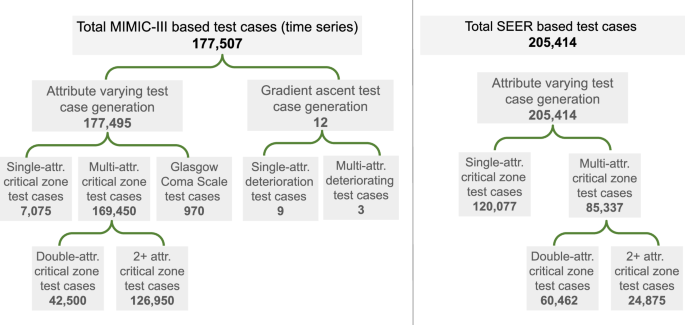
This study evaluates the accuracy of machine learning models in predicting serious disease outcomes: 48-hour in-hospital mortality risk, 5-year breast cancer survivability, and 5-year lung cancer survivability. Three datasets—MIMIC-III, eICU, and SEER—were used, employing models such as LSTM, MLP, and XGBoost. To test model robustness, various test case generation methods were designed, including attribute-based variations, gradient ascent, and Glasgow Coma Scale-based approaches. The study assessed model performance on these challenging cases, revealing varying performance across datasets and methods, highlighting the need for further improvements to enhance reliability.

AI-Powered Romance Scam Costs Woman $300,000

2025-03-29
AI-Powered Romance Scam Costs Woman $300,000

Evelyn, a Los Angeles woman, lost $300,000 to a romance scam orchestrated through the Hinge dating app. The scammer, posing as "Bruce," lured her into a cryptocurrency investment scheme, ultimately stealing her life savings. This case highlights the growing use of AI in scams: AI writing tools make it easier to create convincing narratives, while deepfakes enhance credibility, making scams harder to detect. Evelyn's story serves as a cautionary tale, emphasizing the importance of caution in online dating and the dangers of high-yield investment promises.

Can AI Replace Research Scientists? UF Study Says No (Mostly)

2025-03-29
Can AI Replace Research Scientists?  UF Study Says No (Mostly)

A University of Florida study tested generative AI's ability to conduct academic research. While AI excelled in ideation and research design, it struggled significantly with literature review, results analysis, and manuscript production, requiring substantial human oversight. Researchers advocate for high skepticism towards AI outputs, viewing them as requiring human verification and refinement. Published in the Journal of Consumer Psychology, the study prompts reflection on AI's role in research—more assistant than replacement.

AI

Krisp Server SDK: Tackling Turn-Taking Challenges in AI Voice Agents

2025-03-29
Krisp Server SDK: Tackling Turn-Taking Challenges in AI Voice Agents

Smooth conversations in AI voice agents are often hampered by background noise. Krisp's new server-side SDK features two advanced AI models, BVC-tel and BVC-app, effectively removing background noise and extraneous voices, improving speech recognition accuracy and naturalness. Tests show Krisp BVC reduces VAD false positives by 3.5x and improves Whisper speech recognition accuracy by over 2x. Supporting various platforms and audio sampling rates, the SDK offers a robust solution for more natural AI voice interactions.

Hackers Win Big at Google's bugSWAT: 579MB Binary Leaks Internal Source Code

2025-03-28

In 2024, a security research team once again won the MVH award at Google's LLM bugSWAT event. They discovered and exploited a vulnerability in Gemini allowing access to a sandbox containing a 579MB binary file. This binary held internal Google3 source code and internal protobuf files used to communicate with Google services like Google Flights. By cleverly utilizing sandbox features, they extracted and analyzed the binary, revealing sensitive internal information. This discovery highlights the importance of thorough security testing for cutting-edge AI systems.

Reverse Engineering LLMs: Uncovering the Inner Workings of Claude 3.5 Haiku

2025-03-28

Researchers reverse-engineered the large language model Claude 3.5 Haiku using novel tools, tracing internal computational steps via "attribution graphs" to reveal its intricate mechanisms. Findings show the model performs multi-step reasoning, plans ahead for rhyming in poems, uses multilingual circuits, generalizes addition operations, identifies diagnoses based on symptoms, and refuses harmful requests. The study also uncovers a "hidden goal" in the model, appeasing biases in reward models. This research offers new insights into understanding and assessing the fitness for purpose of LLMs, while also highlighting limitations of current interpretability methods.

AI

LLMs: Stochastic Parrots or Sparks of AGI?

2025-03-28
LLMs: Stochastic Parrots or Sparks of AGI?

A debate on the nature of Large Language Models (LLMs) is coming! Emily M. Bender (coiner of the 'stochastic parrot' term) from the University of Washington will clash with OpenAI's Sébastien Bubeck (author of the influential 'Sparks of Artificial General Intelligence' paper) on whether LLMs truly understand the world or are just sophisticated simulations. Moderated by IEEE Spectrum's Eliza Strickland, the event invites audience participation through Q&A and voting. This debate delves into the fundamental questions of AI and is not to be missed!

AI

The Jevons Paradox of Labor: How AI Is Making Us Work More

2025-03-28
The Jevons Paradox of Labor: How AI Is Making Us Work More

The essay explores the unexpected consequence of AI-driven productivity increases: instead of freeing us, it's leading to a 'labor rebound effect,' where increased efficiency paradoxically leads to more work. This is driven by factors like the soaring opportunity cost of leisure, the creation of new work categories, and intensified competition. The author argues that we need to redefine our metrics of progress, shifting from a singular focus on efficiency to a broader consideration of human well-being, to avoid a 'Malthusian trap.' Examples of alternative metrics include employee time sovereignty, well-being indices, and impact depth. Ultimately, the article suggests that in an AI-powered world, the truly scarce resource is knowing what's worth doing—a deeply personal and subjective question.

AI

Single-Frame Deblurring: Deep Learning for Motion Blurred Video Restoration

2025-03-28

Researchers introduce a novel single-frame deblurring method that calculates motion velocity in motion-blurred videos using only a single input frame. Because the true direction of motion in a single motion-blurred image is ambiguous, the method adjusts the velocity direction based on the photometric error between frames. Gyroscope readings are directly used as angular velocity ground truth, while translational velocity ground truth is approximated using ARKit poses and frame rate. Note that angular velocity axes are x-up, y-left, z-backwards (IMU convention), while translational velocity axes are x-right, y-down, z-forward (OpenCV convention). The method was evaluated on real-world motion-blurred videos.

AI Intelligence Tests: Are Good Questions More Important Than Great Answers?

2025-03-27
AI Intelligence Tests: Are Good Questions More Important Than Great Answers?

The author took the "Humanity's Last Exam," a test designed to assess AI intelligence, and failed miserably. This led him to reflect on how we evaluate AI intelligence: current tests overemphasize providing correct answers to complex questions, neglecting the importance of formulating meaningful questions. True historical research begins with unique, unexpected questions that reveal new perspectives. The author argues that AI progress may not lie in perfectly answering difficult questions, but in its ability to gather and interpret evidence during research and its potential to ask novel questions. This raises the question of whether AI can ever produce valuable historical questions.

AI-Generated Creative Works: The Surprising Gap Between Bias and Consumer Behavior

2025-03-27
AI-Generated Creative Works: The Surprising Gap Between Bias and Consumer Behavior

A recent study reveals a surprising gap between people's stated preferences and their actual consumption behavior regarding AI-generated content. Participants, while expressing a preference for human-created short stories, invested the same amount of time and money reading both AI-generated and human-written stories. Even knowing a story was AI-generated didn't reduce reading time or willingness to pay. This raises concerns about the future of creative industry jobs and the effectiveness of AI labels in curbing the flood of AI-generated work.

It's Time to Abandon Chat Interfaces for Human-AI Interaction

2025-03-27

This article critiques the anti-pattern design of chat interfaces in human-AI interaction. The author uses their experience building a chat-based calendar agent as an example, highlighting its inefficiency compared to traditional graphical user interfaces (GUIs). The author argues that for most transactional tasks, the information abstraction layer of a GUI is far more effective, saving time and effort. Chat interfaces are better suited for social interaction, not tasks requiring precise instructions. The future of human-AI interaction should move towards hybrid interfaces, integrating the intelligence of LLMs into GUIs to avoid cumbersome prompt engineering and enhance user experience.

The UK's National AI Institute: A Case Study in University-Led Failure

2025-03-27
The UK's National AI Institute: A Case Study in University-Led Failure

The Alan Turing Institute (ATI), intended to be the UK's leading AI institution, is in crisis due to mismanagement, strategic blunders, and conflicts of interest among its university partners. The article details the ATI's origins and how it became a university-dominated, profit-driven consultancy rather than a true innovation hub. The ATI neglected cutting-edge research like deep learning, focusing excessively on ethics and responsibility, ultimately missing the generative AI boom. This reflects common issues in UK tech policy: unclear goals, over-reliance on universities, and a reluctance to abandon failing projects. The defense and security arm, however, stands as a successful exception due to its industry and intelligence agency ties.

Anthropic's Claude 3.7 Sonnet: AI Planning Skills on Display in Pokémon

2025-03-27
Anthropic's Claude 3.7 Sonnet: AI Planning Skills on Display in Pokémon

Anthropic's latest language model, Claude 3.7 Sonnet, demonstrates impressive planning capabilities while playing Pokémon. Unlike previous AI models that wandered aimlessly or got stuck in loops, Sonnet plans ahead, remembers its objectives, and adapts when initial strategies fail. While Sonnet still struggles in complex scenarios (like getting stuck on Mt. Moon), requiring improvements in understanding game screenshots and expanding the context window, this marks significant progress in AI's strategic planning and long-term reasoning abilities. Researchers believe Sonnet's occasional displays of self-awareness and strategy adaptation suggest enormous potential for solving real-world problems.

ChatGPT's AI Image Generator Sparks Copyright Debate

2025-03-27
ChatGPT's AI Image Generator Sparks Copyright Debate

ChatGPT's new AI image generator has gone viral, with users creating Studio Ghibli-style images and sparking a copyright debate. The tool can mimic the styles of specific studios, like Studio Ghibli, even transforming uploaded images into the chosen style. This functionality, similar to Google Gemini's AI image feature, raises concerns about copyright infringement, as it easily recreates the styles of copyrighted works. While legal experts argue that style itself isn't copyrighted, the datasets used to train the model may be problematic, leaving the issue in a legal gray area. OpenAI stated it allows mimicking broad styles, not individual artists', but this doesn't fully resolve the controversy.

NotaGen: An AI Composer Mastering Classical Music via Reinforcement Learning

2025-03-26
NotaGen: An AI Composer Mastering Classical Music via Reinforcement Learning

NotaGen, an AI music generation model, is pre-trained on 1.6 million pieces of music to learn fundamental musical structures. It's then fine-tuned on a curated dataset of 8,948 classical music scores, enhancing its musicality. To further refine both musicality and prompt control, the researchers employed CLaMP-DPO, a reinforcement learning method using Direct Preference Optimization and CLaMP 2 as an evaluator. Experiments showed CLaMP-DPO effectively improved both controllability and musicality across various music generation models, highlighting its broad applicability.

Waymo's Self-Driving Accident Analysis: Are Humans the Real Culprits?

2025-03-26
Waymo's Self-Driving Accident Analysis: Are Humans the Real Culprits?

This article analyzes 38 serious accidents involving Waymo self-driving cars between July 2024 and February 2025. Surprisingly, the vast majority of these accidents were not caused by Waymo vehicles themselves, but rather by other vehicles driving recklessly, such as speeding and running red lights. Waymo's data shows that its self-driving vehicles have a much lower accident rate than human drivers. Even if all accidents were attributed to Waymo, its safety record is still significantly better than human drivers. Compared to human driving, Waymo has made significant progress in reducing accidents, especially those resulting in injuries.

AI
1 2 26 27 28 30 32 33 34 40 41